Harvey Milk Terminal 1
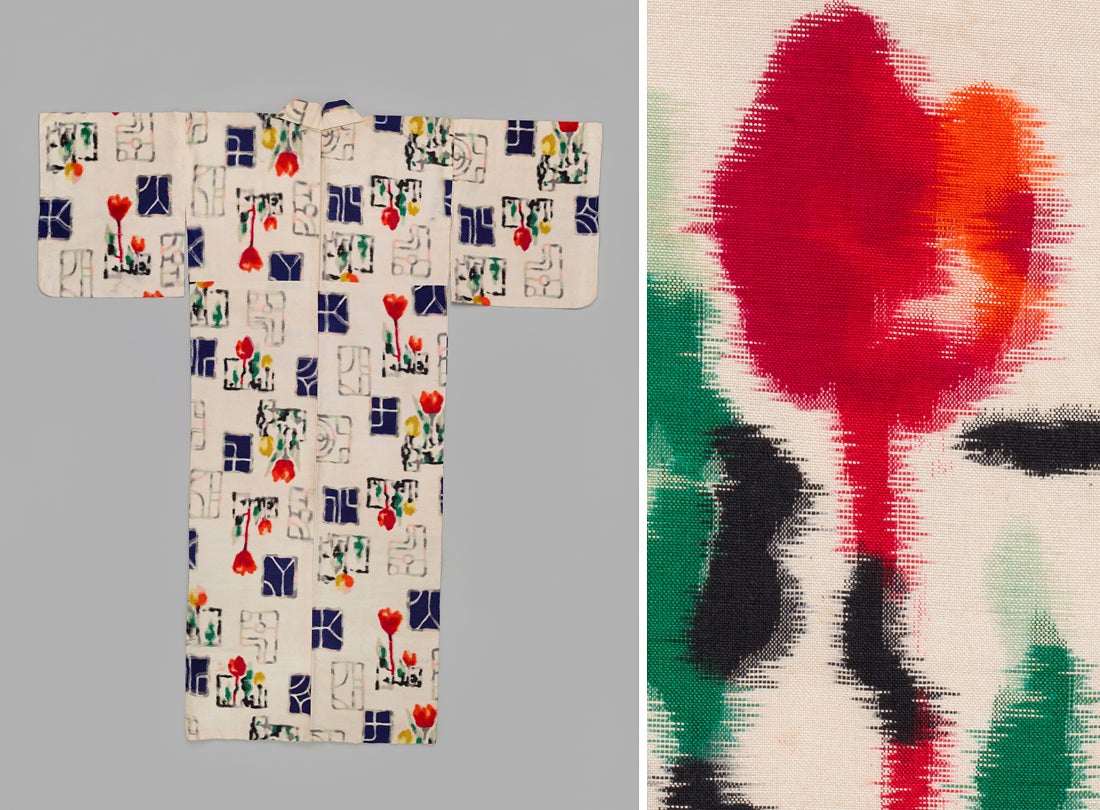
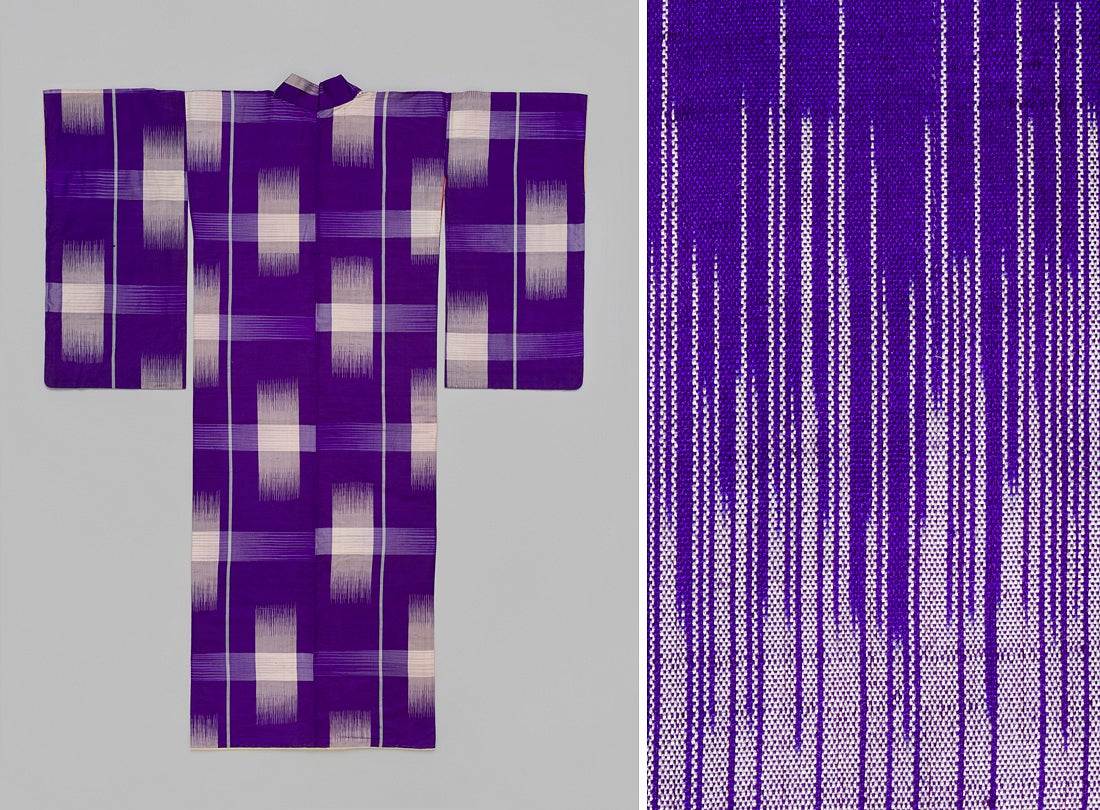
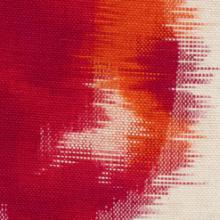
Meisen kimono with tulips 1930s
early Shōwa era (1926–41)
Japan
silk, dye
Collection of Dr. Yoshiko I. Wada
JM338; L2026.1501.005
The Kimono
A general term for clothing since the Meiji era (1868–1912), the word kimono, or “thing to wear,” derives from kiru (to wear) and mono (thing). In the Western world, however, the term “kimono” came to refer broadly to any T-shaped outer garment. The kimono’s predecessor, the kosode, or small-sleeved robe, was worn by both men and women and evolved over many centuries. During the Edo period (1603–1868), textile arts flourished, and the kimono most people are familiar with today emerged from the robes of this era. From a single bolt of fabric, two long panels, wrapped vertically from floor to shoulder and down the back, form the body of the garment; two more panels form the sleeves. The garment is worn wrapped left over right and secured with an obi sash. Its length can be easily altered by drawing up excess fabric, folding it over, and concealing it under the obi sash. A lined kimono provides warmth in the colder weather, while an unlined summer kimono keeps the wearer cool. Unlike Western clothing, which is cut and shaped to the body’s contours, the kimono is defined by its surface. Through color, pattern, motif, and sleeve length, wearers traditionally communicated gender, age, status, and taste. Today, while Western clothing has replaced the kimono, it remains an integral part of Japanese culture and is still worn at weddings, ceremonies, and festivals.
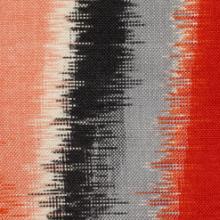
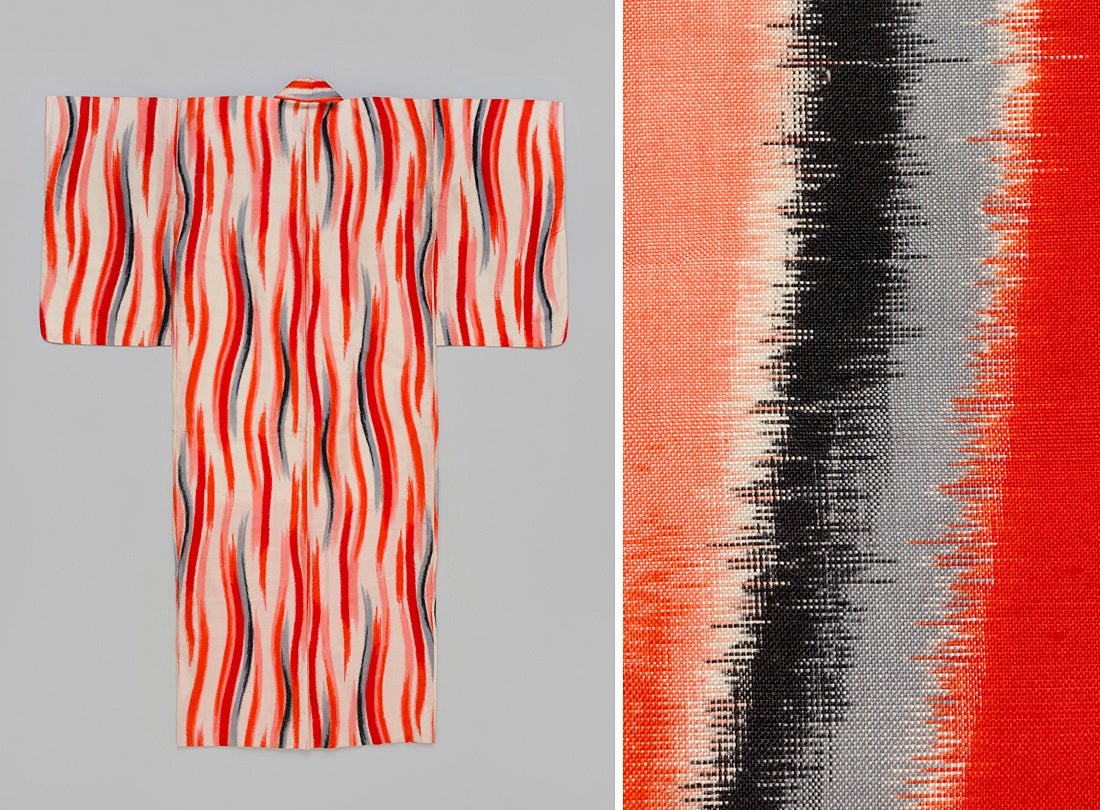
Meisen kimono with undulating lines 1930s–50s
Shōwa era (1926–89)
Japan
silk, cotton, dye
Collection of Dr. Yoshiko I. Wada
JM451; L2026.1501.012
The Silk Industry
Silk was introduced from China to Japan via the Korean Peninsula around the fourth century CE by artisans skilled in sericulture: the cultivation of silkworms to produce silk. The silkworm spins its cocoon from a single continuous filament of natural thread. When boiled and reeled, this filament produces a lustrous, fine silk. A second, less refined silk, first produced in the late 1880s, called meisen, was spun from defective or irregular cocoons and provided a far more affordable alternative to traditional silk. During the Meiji era (1868–1912), the Japanese government and private sector actively promoted silk production, introducing machine-reeling technology from Europe to industrialize production. They also established training centers for dyeing and technical schools for weaving.
Women, many from rural areas, made up the bulk of the labor force in silk-producing mills, working long, stringent hours processing and reeling silk, spinning yarn, and weaving cloth while living in dormitory-provided facilities. Their small incomes often helped provide for their agrarian families. The revenue generated from Japan’s textile exports—principally silk and cotton—funded the country’s rapid modernization. By the early twentieth century, Japan had become the leading silk exporter, supplying the United States with most of its imported raw silk. Much of this satisfied the American women’s demand for silk stockings, a fashion staple. These advances made possible the extraordinary boom in the production of women’s meisen kimono in the 1920s and ’30s.
Meisen kimono
Taishō (1912–26) or early Shōwa era (1926–41)
Japan
silk, cotton, dye
Collection of Dr. Yoshiko I. Wada
JM511; L2026.1501.022
The Making of Meisen
Although meisen permeated Japanese society from Sapporo to Osaka, production was concentrated in a large expanse of flat, cultivable land shaped by the Tone River: the Kantō region near Tokyo, including Isesaki, Chichibu, Kiryu, Hachioji, and Ashikaga. On the slopes and fields between the mountains and the Kantō Plain, farmers planted mulberry trees and engaged in sericulture, supplying the raw material that fueled the meisen industry. By repurposing defective, damaged, or pierced silkworm cocoons and spinning flawed fibers into yarn, meisen manufacturers dramatically lowered silk production costs.
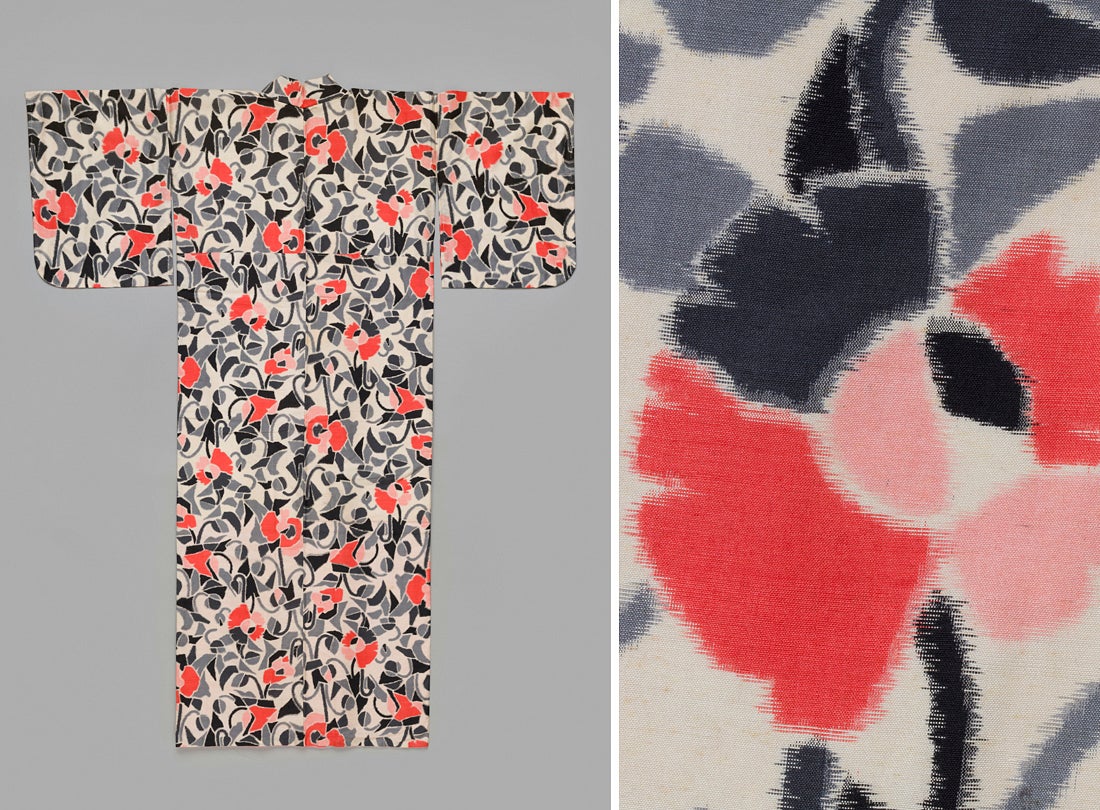
Manufacturers used a variety of ingenious printing techniques, based on traditional kasuri (ikat) and katazome (stencil-printing), producing free-spirited, often unconventional designs in short runs. For example, in the hogushi method, weft yarns were left monochrome, while warp yarns were stretched on a long printing board and loosely held in place with temporary weft threads, then patterned with paper stencils using dye paste—one stencil per color, layered to build rich combinations. Once dyeing was complete, the temporary threads were removed, and the dyed warps were transferred to a loom and woven into fabric. Using the heiyo method, both warp and weft yarns were stencil printed. The use of multiple stencils and colors developed around 1930, allowing makers to achieve complex pictorial designs. The inevitable shifting of threads during weaving produced slightly blurred outlines, giving meisen its characteristic soft-edged quality, reminiscent of the laborious and costly, time-honored technique of resist-binding kasuri.
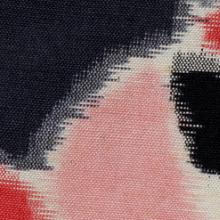
Meisen kimono with floral pattern 1930s
early Shōwa era (1926–41)
Japan
silk, cotton, dye
Collection of Dr. Yoshiko I. Wada
JM218; L2026.1501.011
Students as Fashion Trendsetters
The Meiji government established a national school system in 1872. Among the first institutions for girls were private schools that catered to the daughters of the upper classes. In 1899, the Girls’ High School Order, which required each prefecture to establish at least one girls’ secondary school, was enacted. As education gradually became more widely accessible, young women from broader backgrounds began to enter public life. These students, known as jogakusei, represented a new era of educated young women.
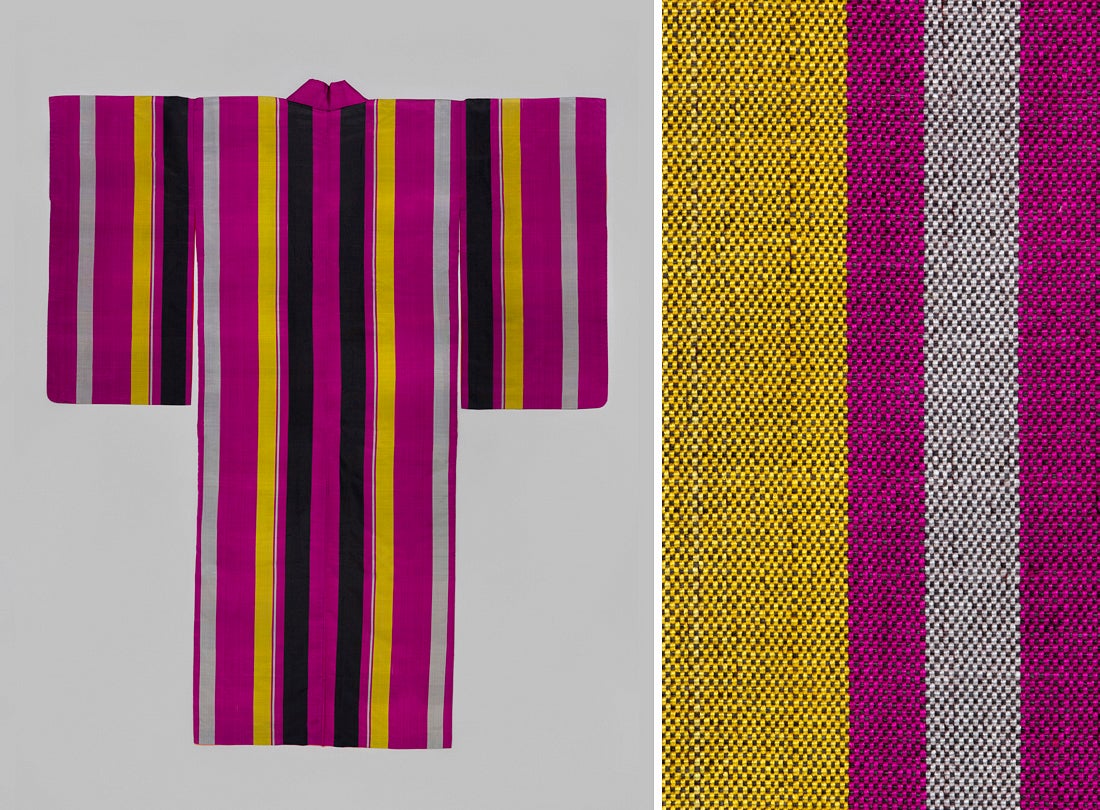
Most women’s schools did not have school uniforms. Although schools encouraged modest dress, affluent students dressed stylishly and were often seen as fashion trendsetters. In 1907, General Nogi Maresuke (1849–1912), the revered principal of the prestigious Gakushūin school in Tokyo, sought to curb his students’ showy attire and suggested meisen as a modest solution. Even so, he realized his pupils preferred distinguished kimono patterns that reflected their social status rather than subdued stripes, a common meisen pattern at the time. Ironically, his policy helped pave the way for bolder-patterned pictorial meisen and established meisen as a standard school uniform, particularly in urban areas. The public saw students wearing meisen as daily daytime dress. Soon after, department stores began offering meisen, reflecting student trends, and by the 1920s, meisen morphed into fashionable daytime attire.
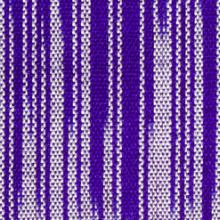
Meisen kimono with stripes (shima)
Taishō (1912–26)–Shōwa era (1926–41)
Japan
silk, cotton, dye
Collection of Dr. Yoshiko I. Wada
JM219; L2026.1501.021
Women, Work, and Modern Life
The rise of meisen coincided with the transformation of women’s lives in early twentieth-century Japan. By the 1910s, women made up more than seventy percent of Japan’s private-sector labor force. Rapid industrialization drew large numbers of women from villages into urban factories, offices, cafés, telephone exchanges, and department stores. For the first time, they had independent incomes and formed an entirely new class of consumers. Yet this newfound freedom conflicted with deeply rooted social expectations. The Meiji-era ideal of ryōsai kenbo, “good wife, wise mother,” still defined respectable womanhood for many Japanese women. Meisen’s affordability and bold modernity made it the ideal expression of their changing status—fashionable and forward-looking yet rooted in Japanese tradition.
Café culture also shaped women’s fashion. After the 1923 Great Kantō Earthquake and reconstruction, thousands of cafés clustered in districts like Ginza, Shibuya, and Shinjuku. Waitresses wore the latest kimono alongside fashionable customers. The moga, or “modern girl”—Japan’s equivalent of the American flapper—captured the public imagination in Western attire and was epitomized by style icons like avant-garde author Uno Chiyo (1897–1996). A divorcée, she cut her hair into a scandalously short bob in 1927 and later launched the fashion magazine Sutairu (Style). But most middle-class and working women made a statement by pairing meisen kimono with a visit to a beauty parlor for a permanent wave or a Shiseido cosmetics counter for the latest lipstick and powder.
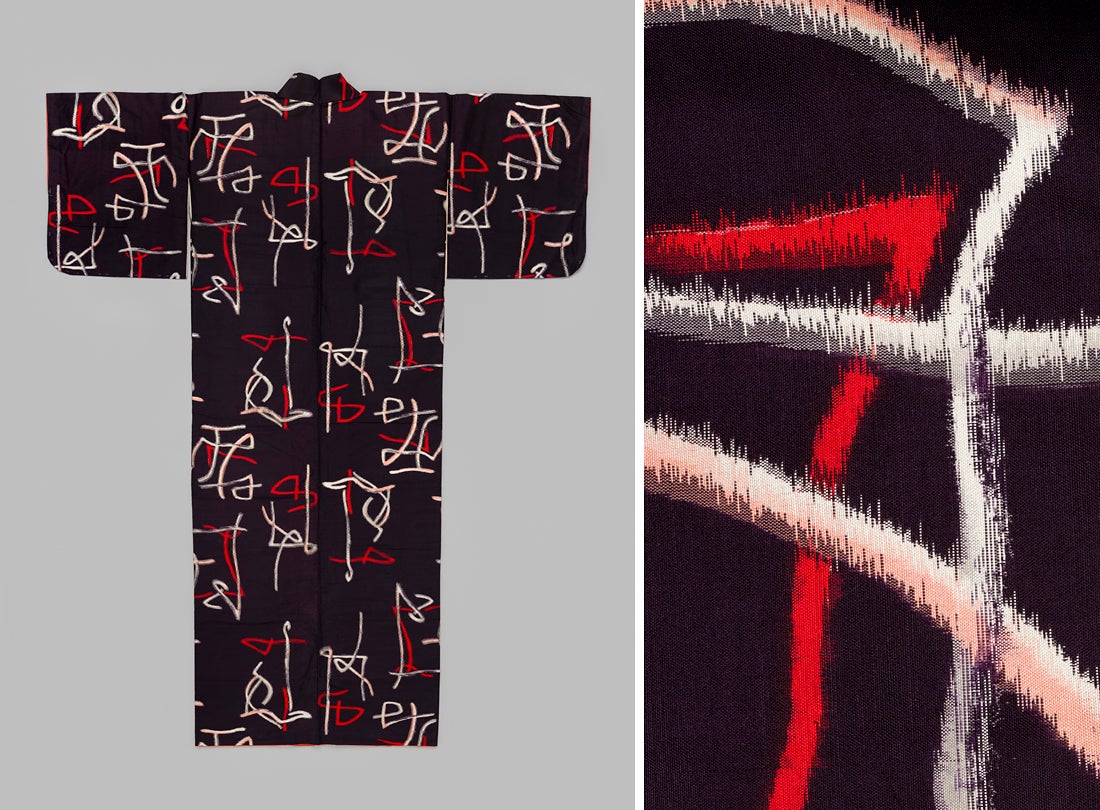
Meisen kimono with abstract lines 1930s–50s
Shōwa era (1926–89)
Japan
silk, cotton, dye
Collection of Dr. Yoshiko I. Wada
JM210; L2026.1501.008
Meisen and Modernism
In the late nineteenth century, Japanese art profoundly affected Western art, from the paintings of Vincent van Gogh to the silver designs of the Gorham Manufacturing Company. Japanese artists traveling abroad, in turn, encountered Western art at venues such as the highly influential Paris Exposition Universelle of 1900, which introduced both the latest technologies and design styles, with Art Nouveau, a Japanese-inspired Western movement, taking center stage. The 1902 pattern book Shin-Bijutsukai (New Ocean of Art), featuring designs by leading Japanese artists, fused modern aesthetics with traditional motifs to inspire kimono and other decorative arts.
This cross-pollination continued in the following decades, as Western images and trends—amplified by the new medium of motion pictures—permeated Japanese cities and were quickly embraced. Western florals, such as tulips and roses, began appearing on kimono alongside dramatically enlarged traditional patterns. Meanwhile, Japanese designers absorbed everything from the geometric grids of Dutch De Stijl to the radical abstraction of the Russian avant-garde. Centuries of stylized motifs, such as ocean waves (seigaiha), primed Japanese artists and designers for this visual experimentation, allowing them to reinterpret new movements with remarkable fluency. And meisen served as the canvas, worn on the streets of mid-century modern Japan.