Terminal 2
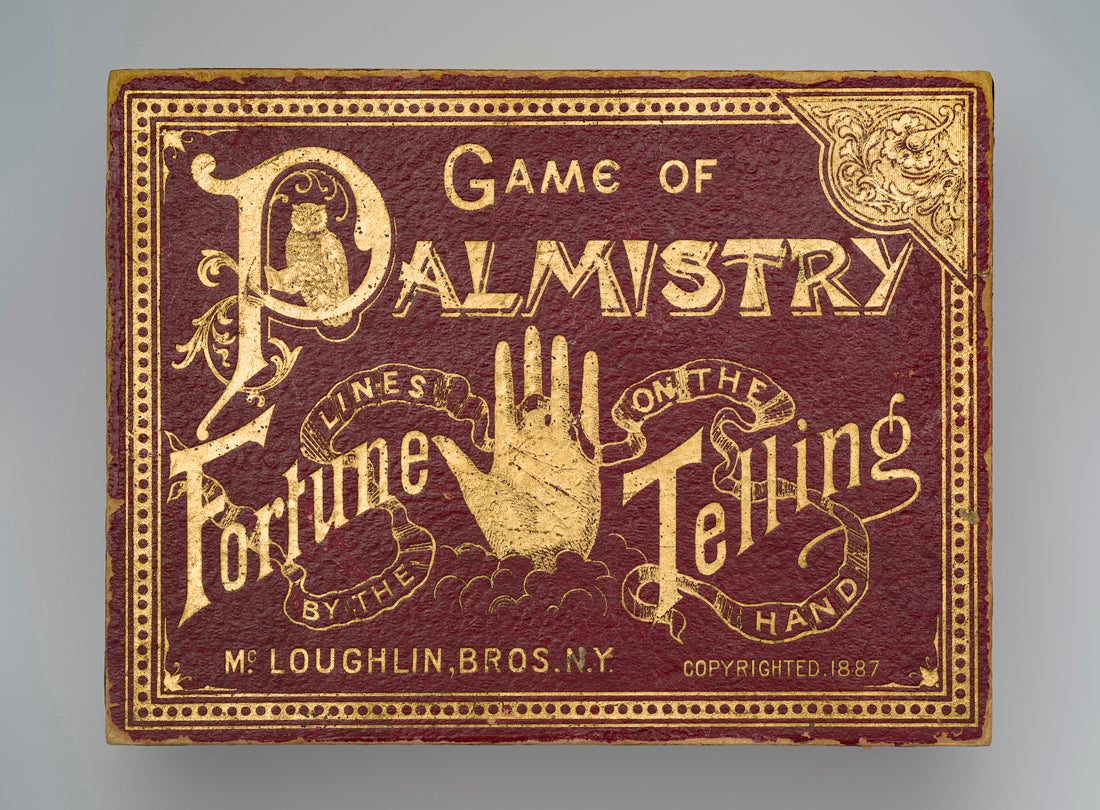
Game of Palmistry 1887
McLoughlin Brothers
New York
Courtesy of Brandie Knight
L2026.0603.019
Palmistry
Practiced across the globe since ancient times, palmistry—or chiromancy—the art of reading character and destiny from the lines and shape of the hand, remains one of humanity’s oldest fortune-telling methods. Practitioners examine the major lines on the palm—most notably the heart line, head line, and life line—interpreting their length, depth, and curvature as indicators of emotional nature, intellect, and vitality. One hand typically reflects inherited traits or destiny; the other shows how life choices have shaped the person.
Palm reading enchanted the public with its blend of pseudoscientific inquiry and mystical allure. One of the most famous palm readers, dubbed Cheiro (1866–1936), the Irish-born seer, read the palms of many notable figures, including Mark Twain and Oscar Wilde. His bestselling books, including Cheiro’s Language of the Hand (1894), set the standard for the modern vocabulary of palmistry. The San Francisco Call launched a palmistry column in 1899, featuring Madam Neergaard. In the February 5 issue, she invited subscribers to send in an impression of their right palm for a free reading, which would be published in the newspaper. Neergaard included instructions for making a palm print at home using gum camphor and smoke, and stated the importance of specifying whether the participant was a Mr., Mrs., or Miss. As she normally charged one dollar for a reading, thousands of readers eagerly sent in their palm impressions.
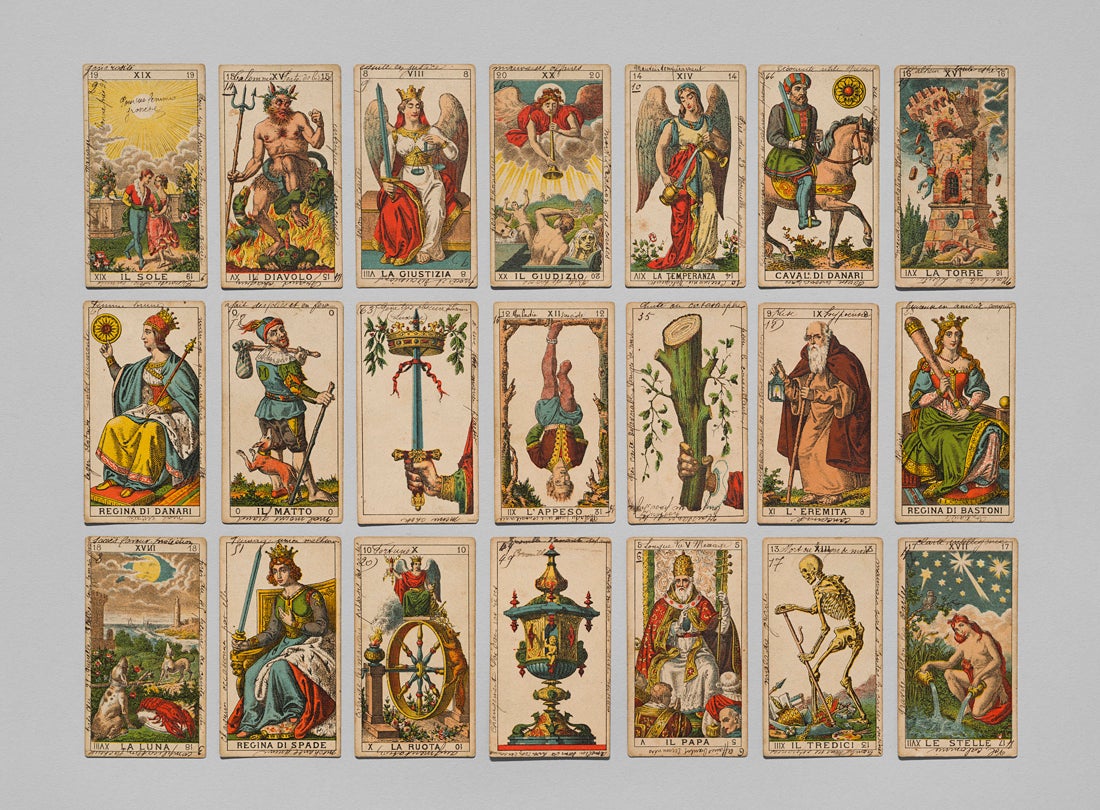
Cards from Soprafino Dellarocca tarot 1883
Avondo Brothers/Cartiera Italiana
Piedmont region, Italy
Courtesy of Cavallini & Co. Archives
L2026.0608.001
Tarot Cards
Tarot first entered Europe through Italy in the fifteenth century as a trick-taking game in which points are scored by capturing specific cards and sets. It took several hundred years for tarot to evolve into its more enigmatic form. Antoine Court de Gébelin exoticized tarot’s origins in Le Monde Primitif (1781), erroneously declaring its mysterious ties to ancient Egypt. In the late 1780s, another French occultist, Jean-Baptiste Alliette, known as Etteilla (1738–91), created the first deck for fortune-telling. He then established the Nouvelle École de Magie (New School of Magic) in Paris to educate students in mystical arts, including training diviners in tarot reading. Since then, numerous occultists have reinterpreted the cards. Introduced in 1909, the influential Rider-Waite tarot deck was created in London by artist Pamela Colman Smith (1878–1951) in partnership with Arthur E. Waite, both members of the Hermetic Order of the Golden Dawn, an esoteric British society that operated during the late nineteenth and early twentieth centuries. The Rider-Waite deck remains among the most widely circulated tarot decks used in fortune-telling.
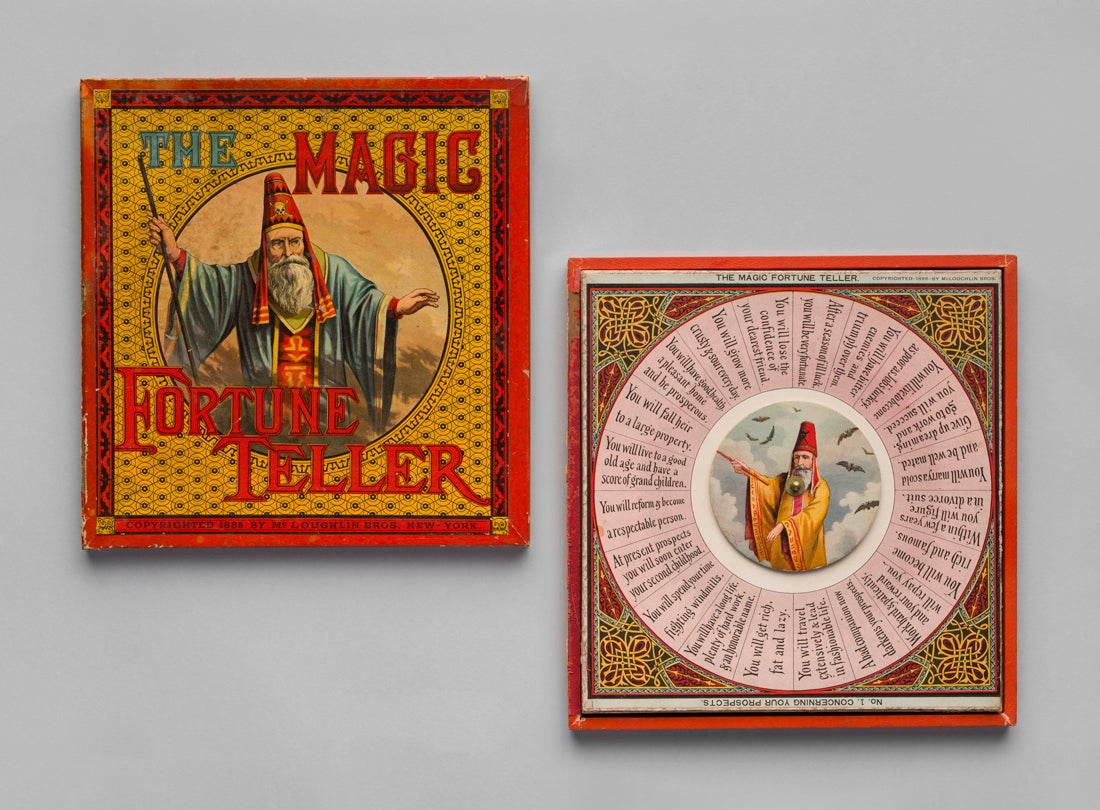
The Magic Fortune Teller 1885
McLoughlin Brothers
New York
Courtesy of Brandie Knight
L2026.0603.007
Fortune-Telling Board Games
Advances in chromolithography, a color printing process perfected in the 1870s, allowed board games to be printed with bold, richly colored images at affordable prices. The games that entertained people mirrored the era’s values, popular culture, current events, and literature. As fortune-telling captivated Victorians, games like The Magic Fortune Teller were produced by leading game manufacturers, such as McLoughlin Brothers in New York and Parker Brothers in Salem, Massachusetts. The Magic Fortune Teller allowed the player to ask questions concerning marriage, one’s disposition, and more. Some answers, like “You will grow more crusty and sour every day,” and “You should not talk so loud, everyone is not deaf,” sound rather abrupt by today’s standards!
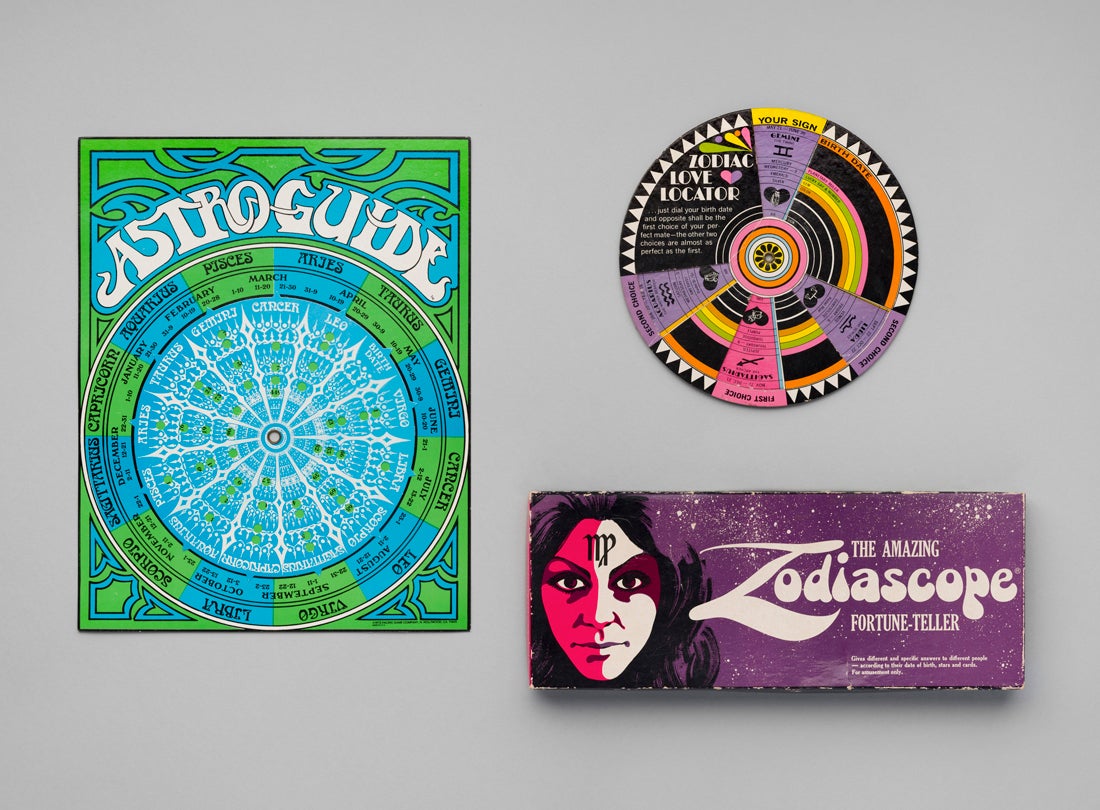
Astro Guide 1975
From: The Compleat Fortune Teller: 10 Ancient Arts
Pacific Game Company
North Hollywood, California
Courtesy of the Salem Witch Board Museum
L2026. 0604.001
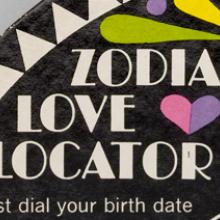
Zodiac Love Locator/Zodiascope Fortune-Teller 1968
Rivlin Distributors/ Zodiac Love Locator Co.
United States
Courtesy of David Brandon Hodge
L2026.0602.017,.025
What’s Your Sign?
The ancient practice of astrology looks at how the positions and movements of celestial bodies—the sun, moon, and planets—at the time of a person’s birth shape their personality, relationships, and life events. It requires astrologers to interpret natal charts to provide detailed, personalized horoscopes. One of the early twentieth century’s most successful astrologers, American “Professor” A. F. Seward (1877–1965), published Humanity and the Zodiac in 1909, promoting a simplified method of sun-sign charting. Seward drew on twelve constellations that form the zodiac from Aries to Pisces, through which the sun appears to travel over the course of a year, with each sign carrying distinct qualities that influence those born under it. Newspaper astrologist R. H. T. Naylor (1889–1952) employed a similar generalized method for his wildly popular 1930s column in London’s Sunday Express. In New York, Bruce King (1897–1976), known as Zolar, and dubbed the “Dean of Astrologers” by The New Yorker, published mass-market daily horoscope guides for nearly half a century. Sun sign readings remain the standard in millions of weekly publications today.
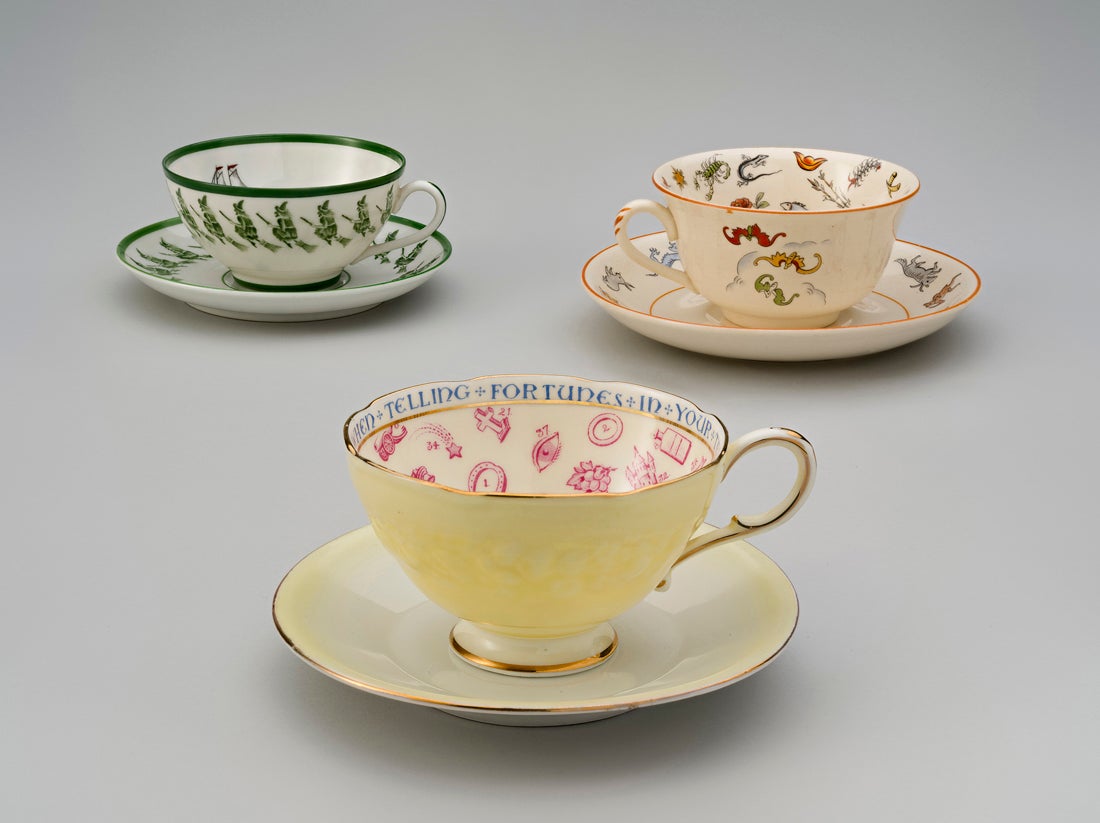
[clockwise]
Flying witch fortune-telling teacup late 19th century
Petersyn Co.
Austria
Courtesy of Brandie Knight
L2026.0603.001a,b
Fortune-telling teacup 1931
Genevieve Wimsatt
United States
Courtesy of the Henry S. Rosenthal Family Collection
L2026.0607.001a,b
Fortune-telling teacup 1950s
Paragon
England
Courtesy of Brandie Knight
L2026.0603.002a,b
Tea Leaf Reading
Reading tea leaves, or tasseomancy, is a form of divination that interprets the patterns left by tea leaves in a cup. In Tea-Cup Reading and the Art of Fortune-Telling by Tea-Leaves (1921), the author gives detailed instructions on the ritual, which is relatively simple. Drink the contents of the cup, leaving only a teaspoon of the liquid and tea leaves at the bottom: Take the cup by the handle in the left hand and move it rapidly three times from left to right, then slowly invert it over the saucer until any remaining liquid drains away. Throughout, the seeker should focus on their future destiny. As one early manual explains, “the turning of the cup before inverting it over the saucer is equivalent to the shuffling of [tarot] cards,” with the subconscious mind directing the hand to create the patterns. The cup is divided into three zones: the rim represents the present, the sides near-future events, and the bottom the distant future. Tea leaves form lines, circles, dots, and recognizable symbols that the seer interprets. Some cups were printed with imagery, numbers, or zodiac signs to aid interpretation. For instance, a clover signifies happiness and prosperity, while a compass foretells travel. Cicely Kent explains in Fortune Telling by Tea Leaves (1922) that some clients have a specific question they would like answered, such as, “Is the sum of money I am expecting coming soon?” When this is the case, the consultant must look solely for signs that will answer the question, ignoring all other points.
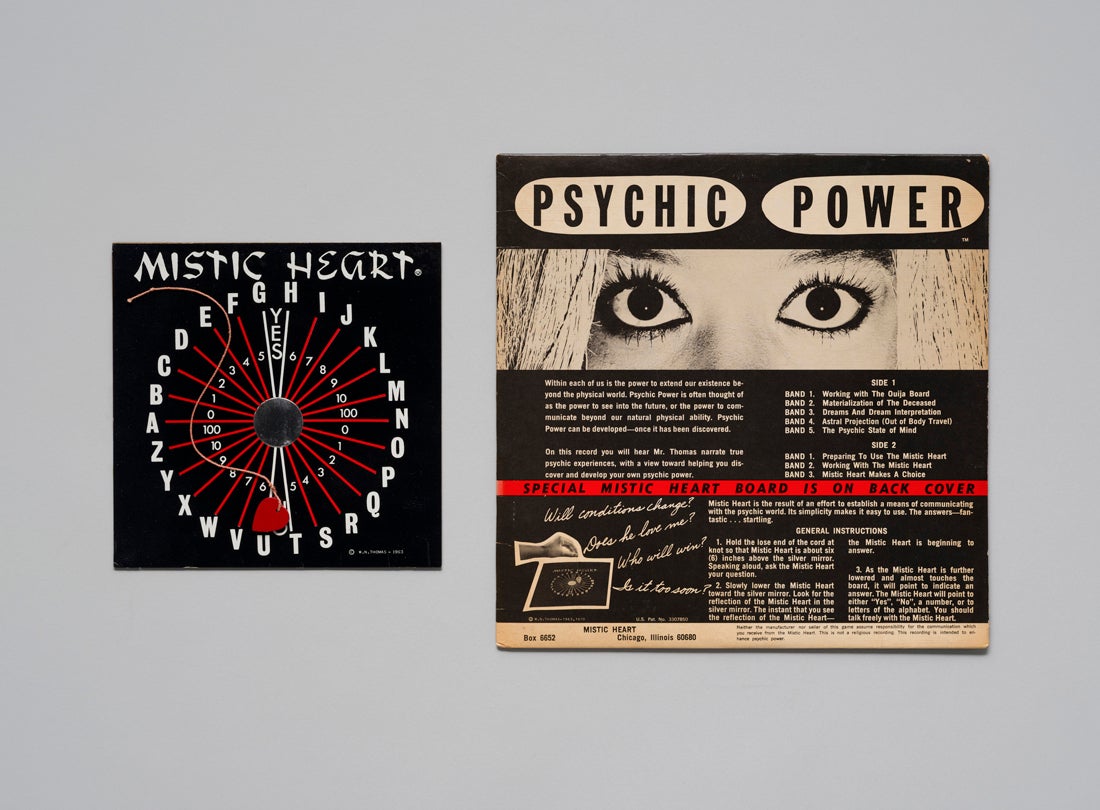
Mistic Heart and Psychic Power album 1963/1970
Walter N. Thomas
Chicago
Courtesy of David Brandon Hodge
L2026.0602.023, .027
Mistic Heart
A pendulum, or weighted object suspended from a string or chain, when held still and asked a question, swings in specific directions to reveal answers. Chicago-based Walter N. Thomas (b. 1925–d.?) copyrighted the name Mistic Heart in 1963, and in 1964, he applied for a patent for his “Magnetically Influenced Question and Answer Game.” He also recorded an LP record packaged with a pendulum set, on which he describes receiving a Ouija board from his aunt shortly after his father died in 1939. To aid the family’s income, his mother used a Ouija board during World War II to predict the winning numbers of an underground “Policy” lottery played by members of Chicago’s Black community. Thomas, who later in his spiritual journey took the title Master Yogi Thomas, claimed to see his father’s materialized spirit and described out-of-body experiences, which inspired the Mistic Heart. Thomas widely advertised his pendulum set and even invited buyers to host “Mistic Heart Fortune-Telling Parties.” Hosts could purchase Mistic Heart boards at bulk rates and then resell them to family and friends.