Give Me a Ring: A Telephone Retrospective
Give Me a Ring: A Telephone Retrospective
By the late 19th century, numerous innovators such as Antonio Meucci, Johann Philipp Reis, and Charles Bourseul had conceptualized two-way voice communication. Alexander Graham Bell, however, obtained the first patent on March 7, 1876, for an “apparatus for transmitting vocal or other sounds telegraphically,” thereby securing the legal rights to the telephone’s development. Ironically, Elisha Gray filed a patent for a telephone several hours after Bell. As the patents shared similarities, the conflict was brought to court, and Bell won the case. Several days after receiving the patent, Bell and his assistant, Thomas A. Watson, made their first successfully transmitted message using a crude liquid transmitter, in which Watson heard Bell exclaim, “Mr. Watson, come here, I want to see you!” On October 9, 1876, Bell and Watson talked to each other over a two-mile wire stretched between Cambridge and Boston. In 1877, with partners, Bell formed the Bell Telephone Company.
Telephone technology continued to grow at a rapid pace. Transcontinental telephone service, made possible by the tube amplifier, officially launched on January 25, 1915. One hundred thirty thousand telephone poles, with copper wires stretching across them, ran through thirteen states. Bell and Watson talked by telephone to each other over a 3,400-mile wire between New York and San Francisco in a call that sounded far clearer than their first conversation thirty-eight years prior. More than a decade later, the first official transatlantic telephone call took place in January of 1927 between New York and London via radio waves.
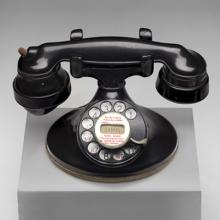
Western Electric manufactured telephones and telephone-related equipment for the Bell System in the United States. The Bell Telephone Company, whose parent company became the American Telephone & Telegraph Company (AT&T) in 1899, dominated the field of telecommunications until the 1980s. Even so, entities such as the Automatic Electric Company, established in 1901, supplied telephone equipment across the United States to independent telephone companies outside of the Bell System. Early telephones had no dials. Making a call required an operator at a switchboard to connect callers. By the 1930s, rotary dialing, which enabled users to make calls without the aid of an operator, prevailed.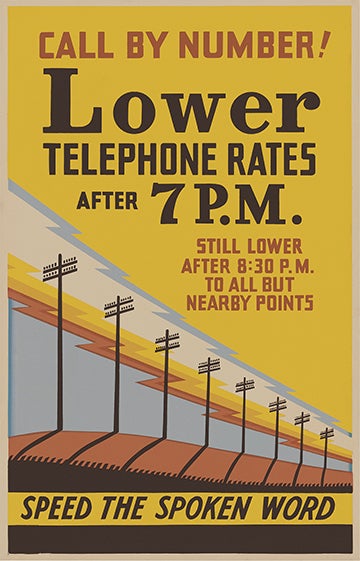
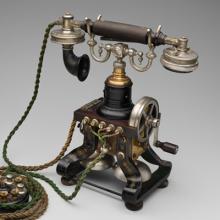
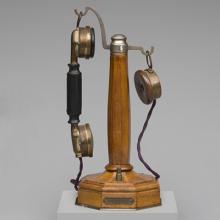
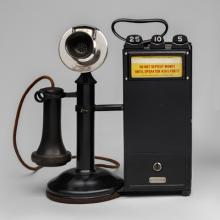
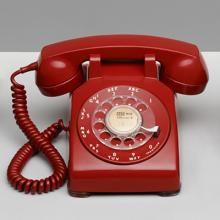
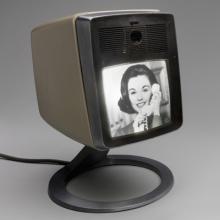
In the era of cell phones, it seems difficult to imagine how revolutionary telephone technology was for its time. Landline telephones work by converting a caller’s voice into electrical signals that travel through wires to another telephone, which then converts the signals back into sound waves. Early types ranged from large wooden wall telephones to candlestick desk sets. The rotary dial telephone, with a handset resting on its base, permeated American homes by the 1930s. This exhibition features an array of classic telephones from the late 19th century to the 1990s—from streamlined Art Deco telephones, payphones, and novel Picturephones of the 1960s to a 1958 Touch-Tone telephone prototype.
This exhibition was made possible through a generous loan from the JKL Museum of Telephony; special thank you to JKL curator Remco Enthoven.
@SFOMuseum
#GiveMeARing
[inset images]
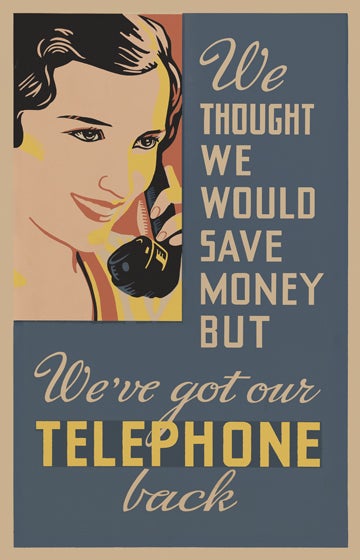
We’ve Got Our Telephone Back c. 1930s
United States
lithograph poster
Collection of the JKL Museum of Telephony
R2025.0701.131
Call by Number! c. 1930s
United States
lithograph poster
Collection of the JKL Museum of Telephony
R2025.0701.126
© 2025 by San Francisco Airport Commission. All rights reserved.