Terminal 2
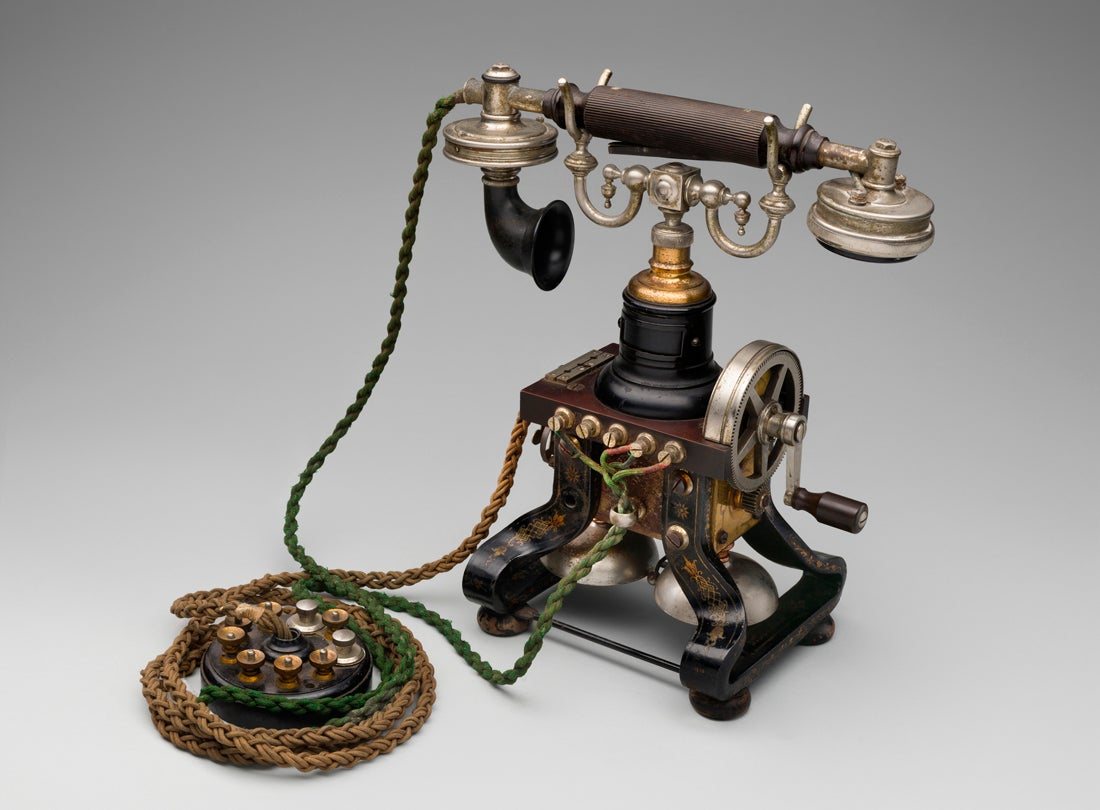
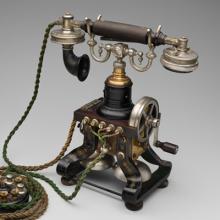
Model 375 (Skeleton/Eiffel Tower) telephone 1890s
LM Ericsson
Stockholm
metal, wood, cloth, hard rubber
Courtesy of Remco Enthoven
21043; L2025.0702.002
Early Desk Telephones
L. M. Ericsson (1846–1926), founder of the influential Ericsson telephone manufacturing company in Sweden, began offering telephones in 1878. Ericsson designed one of the earliest and most influential telephones with a handset resting on its base. Introduced in 1892, the telephone, commonly referred to as the Eiffel Tower, Skeleton, or Sewing Machine due to its high-quality steel construction, served as a model for later desk telephone sets worldwide. Many manufacturers copied the iconic design with its bell ringers tucked under its base. Early telephones like this one had an attached hand crank that produced a current to ring the bells of another telephone or switchboard. The model remained in production until the early 1930s, when less costly materials, such as Bakelite, superseded steel. Even so, some continued to use Skeleton telephones into the mid-20th century.
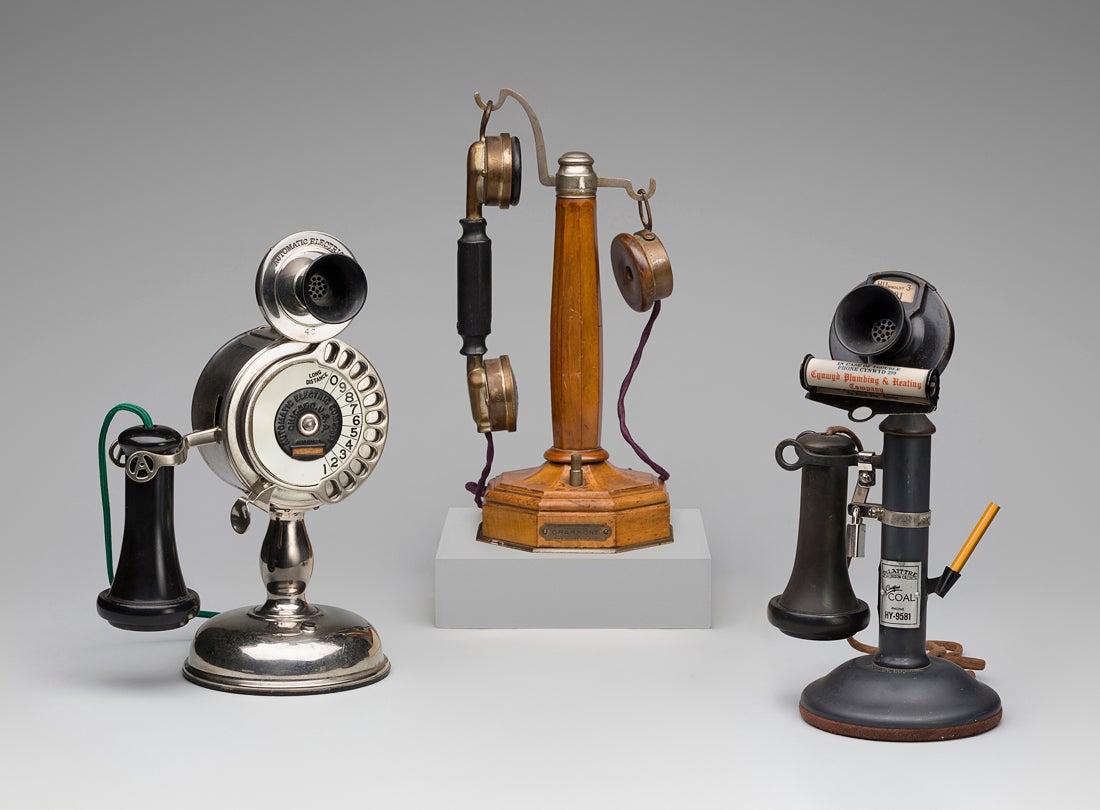
Strowger rotary dial candlestick telephone 1907
Automatic Electric Company
United States
metal, Bakelite, cloth
Collection of the JKL Museum of Telephony
11117; L2025.0701.030
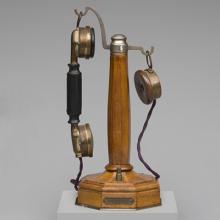
Wooden candlestick telephone 1927
Grammont
Paris
wood, metal, cloth, hard rubber
Courtesy of Remco Enthoven
21005; L2025.0702.004
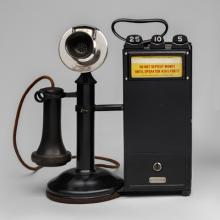
40AL candlestick telephone with locking device c. 1917
Western Electric
United States
Bower-Barff finished metal, hard rubber, cloth
Collection of the JKL Museum of Telephony
12346, 21077; L2025.0701.025, 0702.025
Candlestick Telephones
“From New York to San Francisco…a word can fly by telephone in a twelfth of a second,” exclaimed John Mills in the 1934 edition of The Magic of Communication. On the booklet’s cover, tiny fairies fly from the mouthpiece of a candlestick telephone. The first desk telephone, it was indeed a marvel when introduced in the late 1890s. The device, also referred to as a desk stand, required the caller to speak into the candlestick while holding the receiver to their ear to hear the other party. A stark contrast to the heavy, wooden, cranked wall telephones, early candlesticks lacked a dialing mechanism. To place a call, a person had to speak with a switchboard operator who made the connection to the requested number. Candlesticks, like many other early telephones, had no attached bell or interior ringing mechanism. Instead, a ringer box was installed on a nearby wall. Many considered these novel communication devices ghastly contraptions, so they employed decorative covers or screens to conceal them.
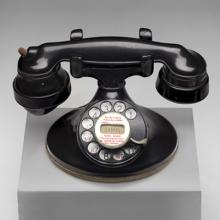
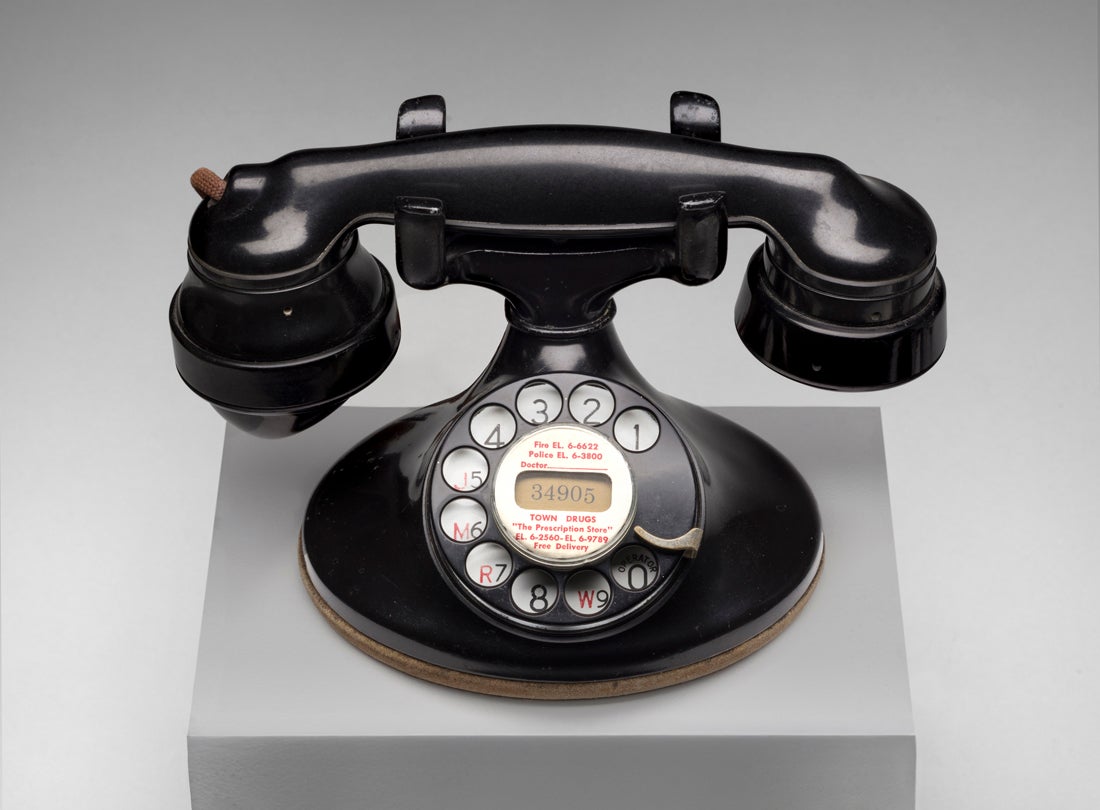
D Handset Mounting 1927
Western Electric
United States
metal, Bakelite, cloth
Collection of the JKL Museum of Telephony
20981, L2025.0701.028
Rotary Dials and Handsets
A revolutionary concept at the time, the first rotary dial telephones allowed people to directly dial a telephone number without the assistance of an operator. In rotary dialing, each number on the dial is associated with a series of electrical pulses. When a caller turns the dial, it sends the pulses down the line. For instance, if one dials ‘7,’ the telephone delivers seven pulses. These pulses are then translated at an automatic telephone exchange to connect the call to the desired number. Almon B. Strowger patented his first automatic telephone exchange in 1891. The rotary dial telephone with holes in the finger wheel did not appear until about 1904. Rotary dial service in the Bell System was uncommon until the 1920s. In another radical development, Western Electric introduced one-piece handsets in 1927, which allowed callers to have one hand free while talking. The first model used the base of their dial candlestick. By 1930, Western Electric released its more refined D Handset Mounting, the prevailing telephone of the decade.
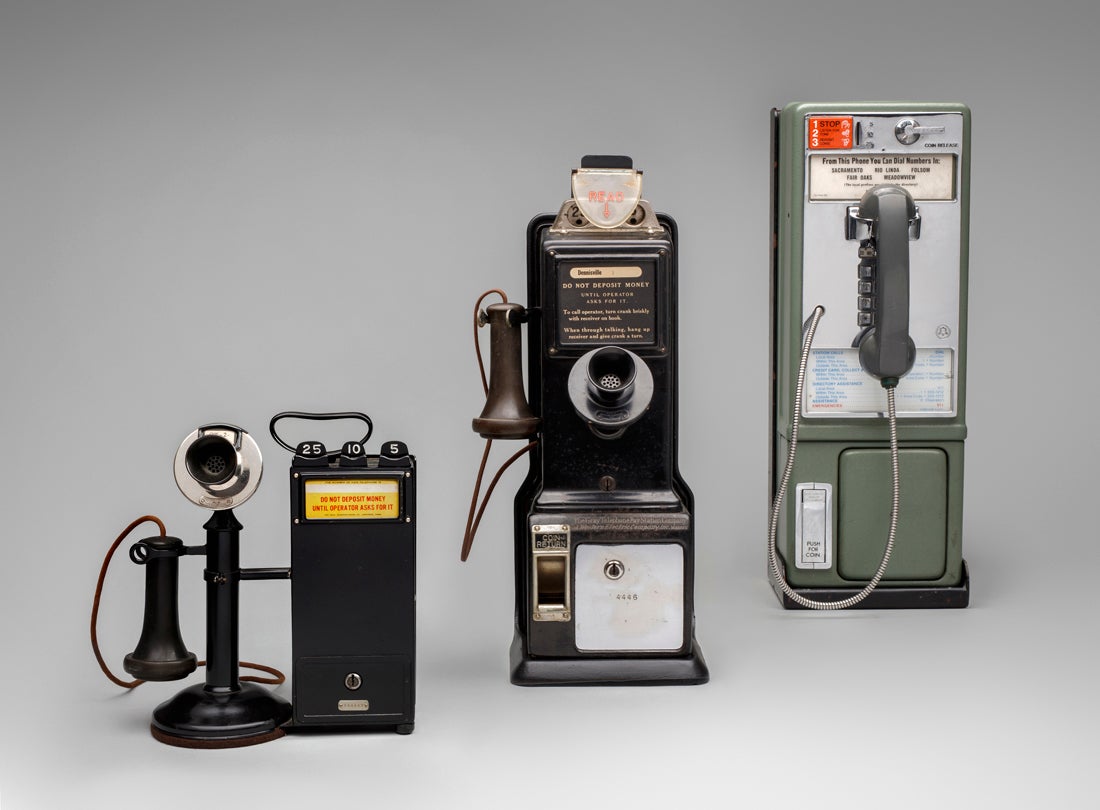
Model 23A stand-alone coin collector c. 1910
Gray Telephone Paystation Company
Hartford, CT
metal, cloth
Collection of the JKL Museum of Telephony
20951; L2025.0701.041
50G 3-slot payphone 1920s
Gray Telephone Paystation Company
Hartford, CT
metal, cloth
Collection of the JKL Museum of Telephony
20509; L2025.0701.042
1C single-slot payphone 1970s
Western Electric
United States
metal, plastic
Collection of the JKL Museum of Telephony
F00062; L2025.0701.043
Payphones
Payphones, now nearly nonexistent, remained an important part of telephone communication until the advent of cell phones. William Gray (1850–1903) patented the first coin-controlled apparatus that used a bell system to signify when a user inserted a coin. Operators listened carefully as coins of different denominations traveled down separate chutes where they struck bells and gongs to verify that the correct payment was received. In 1889, Gray placed the first pay telephone in a bank in Hartford, Connecticut. Payphones gradually spread across the country. In 1911, Western Electric worked with Gray’s company to design a standard payphone with a coin return, the Western Electric Model 50-A, which had three slots: one for nickels, one for dimes, and one for quarters. Within a year, thousands of payphones appeared, housed indoors in wooden booths. Outdoor phone booths made from glass and aluminum became commonplace in the 1950s. In 1965, Western Electric introduced the single-slot, flat-fronted public telephone still familiar to some today.
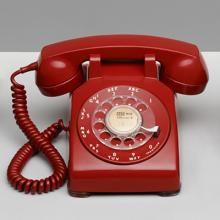
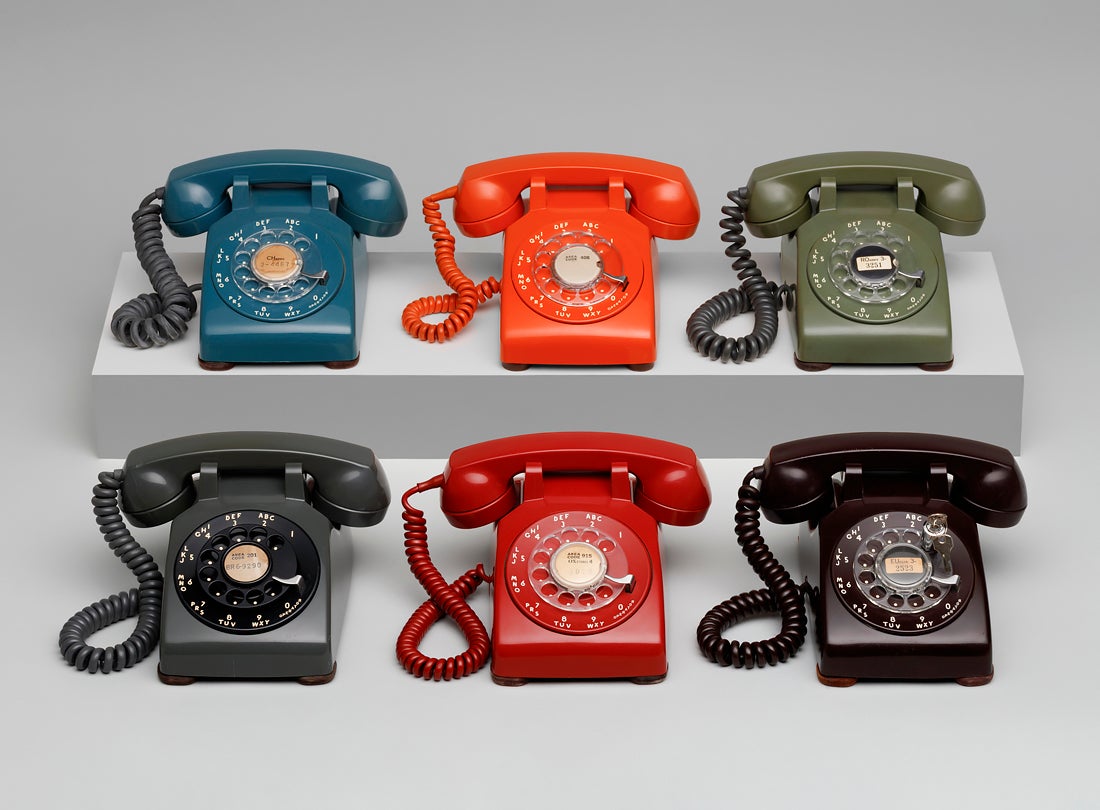
Model 500 desk telephones 1950s
Designed by Henry Dreyfuss (1904–72)
Western Electric / Stromberg-Carlson
United States
plastic, metal
Collection of the JKL Museum of Telephony
F00731, 21060, 21061, 21064, 21062; 21066; L2025.0701.0723, .079, 081-.084
Western Electric Model 500
Since the advent of the telephone, a variety of published booklets have helped explain the “magic” of this device, teaching children and their families how the telephone worked and how to use the dial on a rotary phone—something most young people would have trouble deciphering today! Western Electric’s Model 500 rotary dial desk telephone remained the standard telephone for decades. In November of 1963, the Bell System first offered a Touch-Tone version; the star and pound buttons appeared in 1968. Industrial designer Henry Dreyfuss (1904–72) designed the quintessential Model 500. Development began in 1946, and the telephone debuted in 1949. Millions of earlier Model 302 telephones were replaced with the 500 series due to its improved electrical and acoustic abilities. The numbers and letters on the 500 appeared on the circumference of the dial plate, making them more easily visible. Black phones predominated from 1949–53; color telephones began to emerge from 1954–57. Rotary phones reached their demise by the 1990s. Even so, the word “dial” persists when referring to making a call.
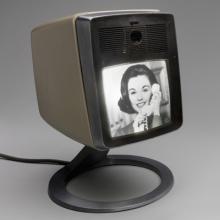
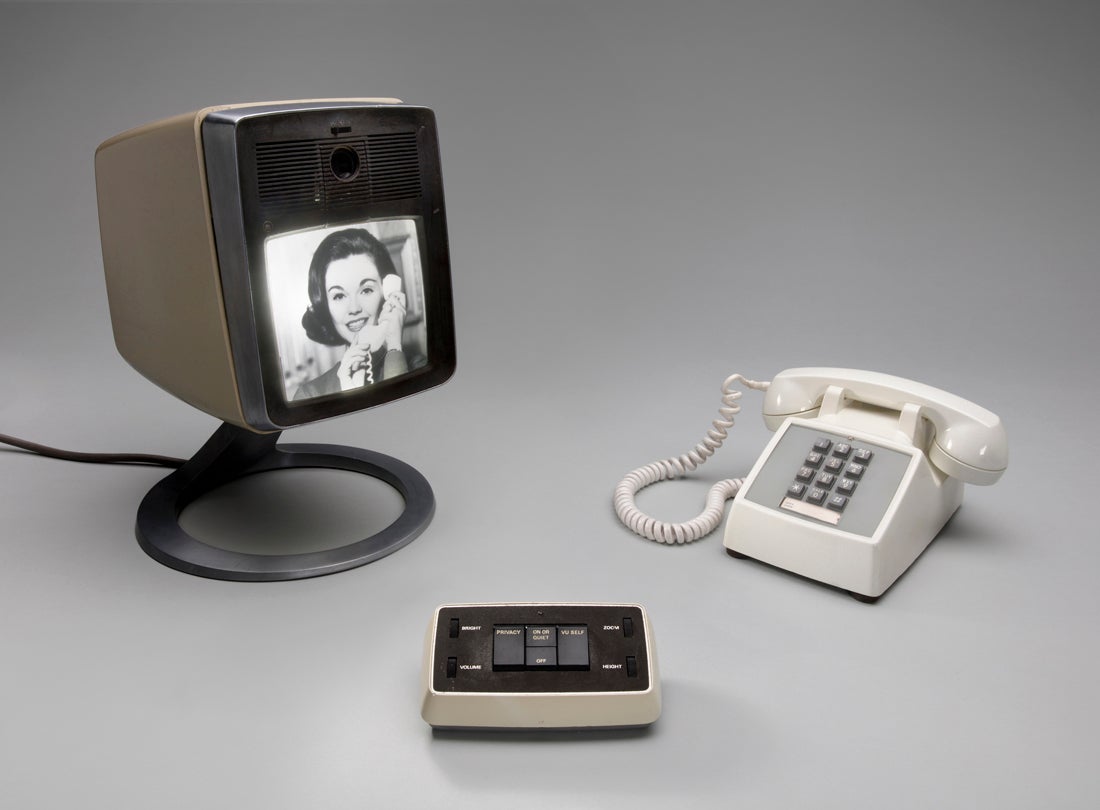
Model II Picturephone 1969
(demonstration model)
Western Electric
United States
plastic, metal, glass
Collection of the JKL Museum of Telephony
F00084, 21072, 21089; L2025.0701.015.01-.03
Picturephones
Many early periodicals and science fiction works conceptualized the idea of a videophone. Even Alexander Graham Bell recorded some conceptual notes about “seeing by electricity.” By the late 1920s, AT&T had created an electromechanical television-videophone, which they successfully tested in 1927. By 1930, AT&T’s “two-way television-telephone system” was used experimentally. After World War II, work on concept models continued into the 1950s. Further developments by AT&T’s Bell Laboratories led to the 1963 Model I Picturephone. It was first demonstrated between the 1964/1965 New York World’s Fair and Disneyland in California. In 1969, the upgraded Model II Picturephone debuted, which employed early integrated circuits. Signals that needed to be transported more than a few miles were digitized using Differential Pulse Code Modulation (DPCM). Both model Picturephones could only transmit black-and-white pictures. AT&T’s Picturephone failed commercially. The company concluded that the videophone was a “concept looking for a market,” and in the late 1970s, service ceased. The development of broadband internet and video compression led to inexpensive video telephony in the early 2000s. Today, with the widespread use of mobile phones and other mobile devices equipped with video capabilities, most people cannot imagine living without video telephone communications.