Jim Marshall: Two Sides of the Same Coin
![The Beatles disembark at SFO [detail] August 29, 1966 Women’s Vietnam Day Committee marches to DeFremery Park in Oakland [detail] 1965](/sites/default/files/hero-jim-marshall-sfom.jpg)
Jim Marshall: Two Sides of the Same Coin
As one of the twentieth century’s most iconic photographers, Jim Marshall is best known for his images of musicians and the countercultural revolution made during the 1960s and ’70s in the San Francisco Bay Area. His unforgettable pictures of artists such as Bob Dylan, Jimi Hendrix, Janis Joplin, and the Rolling Stones helped to both define their public identities and the visual language of rock-and-roll photography itself. Equal parts anthropologist and journalist, Marshall immersed himself in the communities he photographed, earning trust from even the most guarded subjects. This approach enabled him to capture candid moments both on stage and in private, while also documenting the broader social landscape of the United States—from poverty in Appalachia to the streets of New York City after the assassination of President John F. Kennedy.
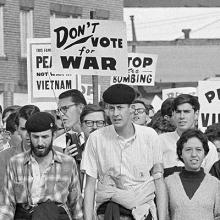
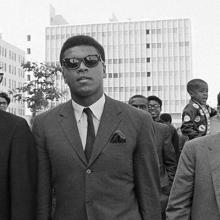
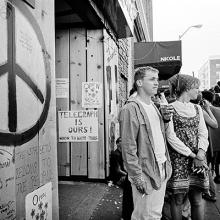
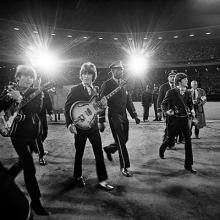
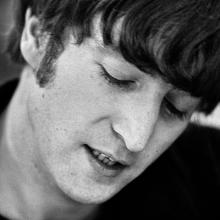
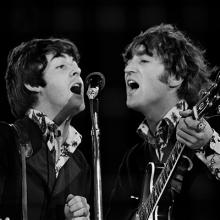
These dual strands—music and social documentary—converge in Jim Marshall: Two Sides of the Same Coin, where the Bay Area becomes the shared ground for both performance and protest. Photographs from the Beatles’ final concert at Candlestick Park pair with scenes of peace, free speech, and anti-war demonstrations across San Francisco, Oakland, and Berkeley. Together, these images speak to the continuity of Marshall’s aesthetic and philosophy as he moved fluidly between subjects.
The Beatles’ concert on August 29, 1966 was their final scheduled live performance. As the only photographer granted backstage access, Marshall documented both the event’s public spectacle and quieter moments behind the scenes: band members doodling, joking, or waiting in weary reflection. His images reveal the paradox of these icons—onstage exuberance set against the exhaustion of fame and constant touring.
Across the Bay Area in the 1960s, and beyond concert stages, Marshall trained his lens on the streets, documenting sit-ins, marches, and campus uprisings that helped define a growing national movement of dissent. His photographs convey the intensity of these demonstrations while also emphasizing the individual within collective action, speaking to the period’s turbulence and its sense of hope.
Across subjects, Marshall maintained a careful balance behind the camera: insistent yet respectful, sensitive without sentimentality, willing both to get close and to observe from afar. His photographs reflect a dedication to craft and a reverence for the medium’s capacity to bear witness, offering a record of a cultural moment that continues to resonate today.
Jim Marshall (American, 1936–2010) was born in Chicago to Assyrian Catholic immigrant parents and raised in San Francisco, where he established his lifelong home and creative base.His work is held in innumerable major museum collections. In 2014, he posthumously received the Recording Academy’s Trustee Award. The documentary Show Me The Picture: The Story of Jim Marshall premiered at the 2019 South by Southwest (SXSW) Film Festival. In December 2025, San Francisco honored him by renaming the block of 16th Street where he lived “Jim Marshall Way.”
Special thank you to Amelia Davis and Bonita Passarelli of Jim Marshall Photography LLC for making this exhibition possible.
@SFOMuseum
#JimMarshall
[image]
The Beatles disembark at SFO [detail] August 29, 1966
Women’s Vietnam Day Committee marches to DeFremery Park in Oakland [detail] 1965
Jim Marshall (1936–2010)
archival pigment prints
Courtesy of Jim Marshall Photography LLC
R2026.1701.031; R2026.1701.006
© 2026 by San Francisco Airport Commission. All rights reserved.