Dianne Feinstein International Terminal
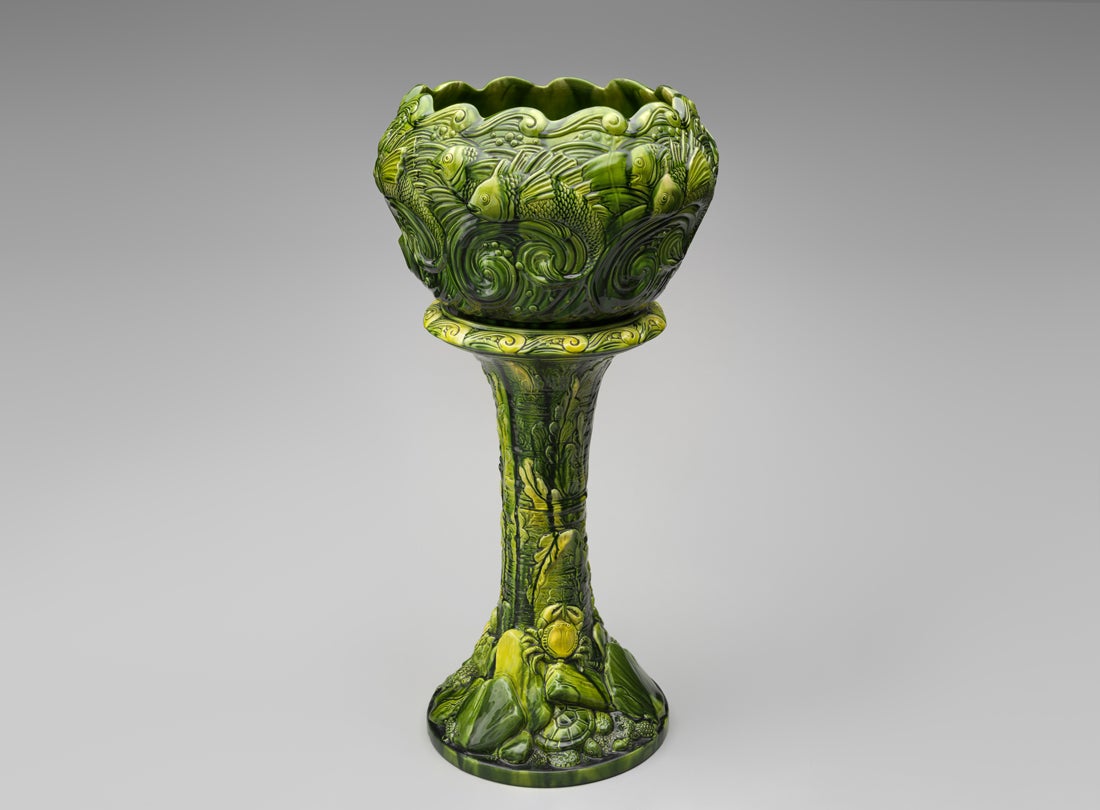
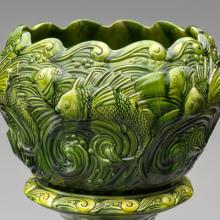
“Oceana” jardinière and pedestal c. 1900
Ault Pottery
Swadlincote, Derbyshire, England
ceramic, glaze
Collection of Brian D. Coleman
L2025.0501.001.01-.02
Thomas Fairchild
Before the Victorian era, Thomas Fairchild (1667–1729), a horticulturalist ahead of his time, established a successful nursery in the North London neighborhood of Hoxton in 1690. He published City Gardener in 1722, which identified dozens of plants that could withstand the smoky, coal-burning air in London. Fairchild’s book grappled with issues we still face today, such as pollution and advocating for gardens and green spaces in dense urban areas. He also recommended suitable flora for city dwellers to grow in unused fireplaces and window boxes, on balconies, and even on the tops of dwellings amid chimneys. Fairchild’s innovative publication encouraged gardening among all urbanites during a time when gardening publications were geared towards wealthy landowners. He also noted the mental health benefits of gardening, or increasing one’s “Quiet of Mind,” as he described it.
Fairchild created the first documented, deliberate hybrid flower around 1717 in England when he cross-pollinated a carnation (Dianthus caryophyllus) with a sweet William (Dianthus barbatus). Referred to as “Fairchild’s mule” because the sterile plant could not reproduce, it would be another century before commercial hybridization practices ensued. By the late 1800s, seed and nursery companies had begun crossing species, offering a variety of ornamental hybrids with color variations, enhanced resilience, and improved flowering.
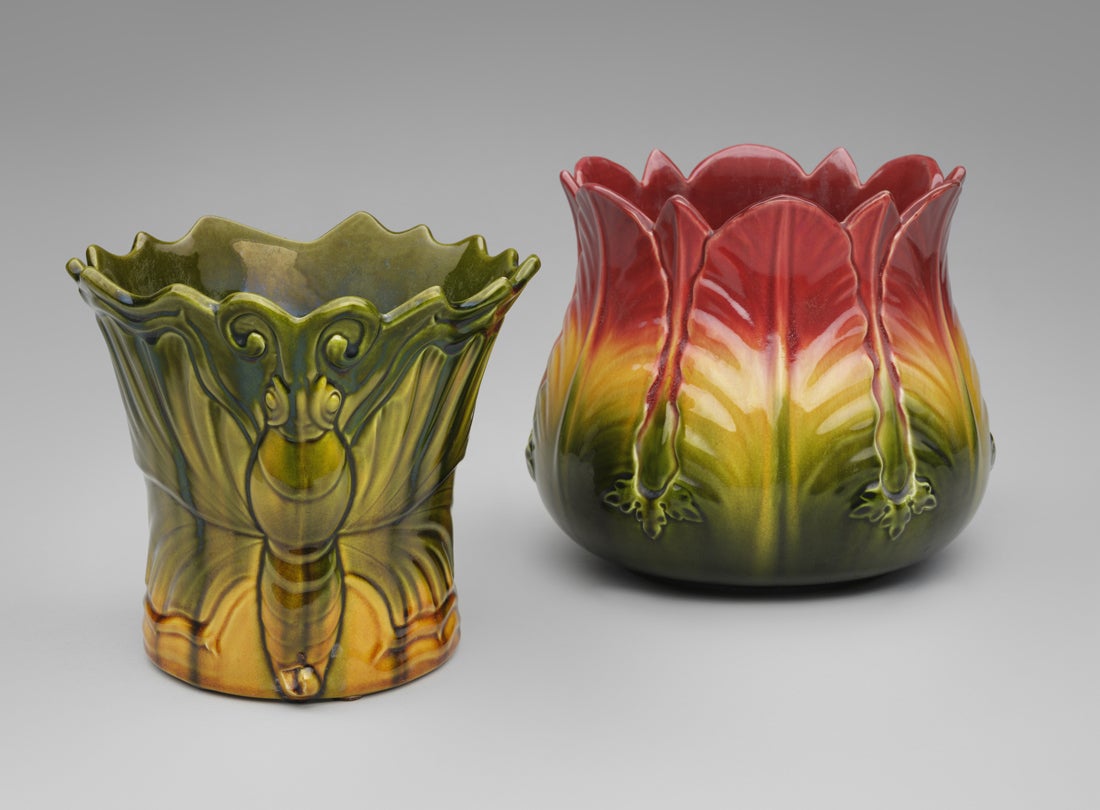
Stylized butterfly vase c. 1893
Designed by Christopher Dresser (1834–1904)
Ault Pottery
Swadlincote, Derbyshire, England
ceramic, glaze
Collection of Brian D. Coleman
L2025.0501.003
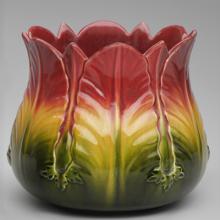
Stylized leaves jardinière c. 1900
Ault Pottery
Swadlincote, Derbyshire, England
ceramic, glaze
Collection of Brian D. Coleman
L2025.0501.009
The Language of Flowers
Originating in France, floriography, or the language of flowers, captivated Victorians more as a popular amusement than as a serious practice. One of the earliest books on the subject, Le Langage des Fleurs (1819) by Charlotte de la Tour, outlined several hundred meanings associated with various flowers used in making bouquets. This was followed by the English publication Floral Emblems (1825) by botanist, horticultural writer, and gardener Henry Phillips. A plethora of books appeared in both the United Kingdom and North America—some simple dictionaries, others with elaborate illustrations, poetry, and horticultural information. As so many authors published books, the symbolic meaning of each flower might vary from one publication to the next, and in some instances, modified to appeal to more modest sensibilities. The tuberose symbolized “dangerous pleasures” in some guides and “voluptuousness” in others. Forget-me-nots meant true love, ferns stood for fascination, the iris: eloquence, the nettle: cruelty, the French marigold: jealousy, and the narcissus: egotism. Floral bouquets and arrangements served as carefully crafted messages conveying emotions and social cues—often between courting couples. Decorative posy holders held small bouquets or nosegays that could be adhered to ladies’ garments. This floral vocabulary was also reflected in the art, poetry, and garden design of the period.
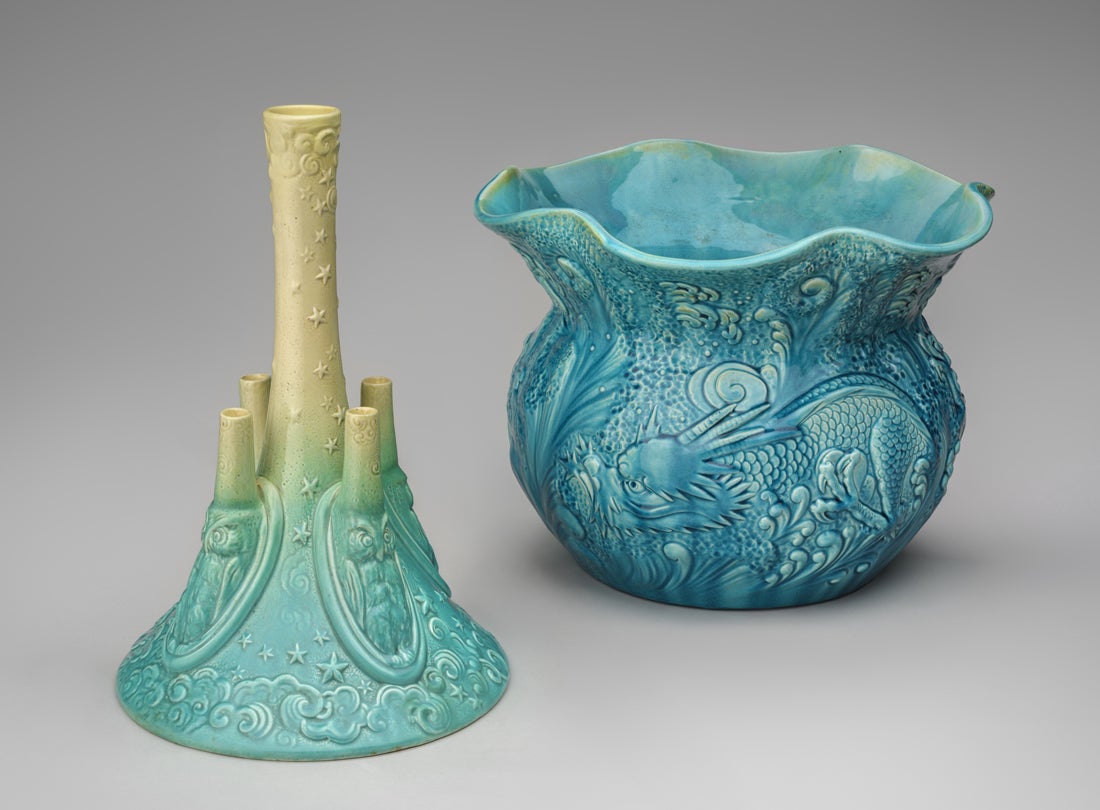
Owl vase c. 1890
Designed by Christopher Dresser (1834–1904)
Ault Pottery
Swadlincote, Derbyshire, England
ceramic, glaze
Collection of Brian D. Coleman
L2025.0501.015
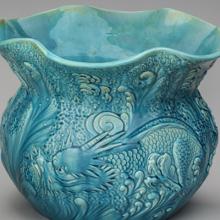
Dragon jardinière c. 1890
Bretby Art Pottery
Woodville, Derbyshire, England
ceramic, glaze
Collection of Brian D. Coleman
L2025.0501.016
British Art Pottery
Pottery output reflected the design styles popular throughout each era. The Arts and Crafts and Aesthetic movements flourished in England during the last several decades of the nineteenth century. The former emphasized that everyday objects should be both useful and beautiful; the latter championed “art for art’s sake,” with a focus on decorative arts. Both drew inspiration from the natural world and the arts of Japan. These styles permeate the ceramics on display, as does the influence of the famed British designer Christopher Dresser. Many art potteries set up workshops and manufactories during this period, such as Linthorpe Art Pottery, Bretby Art Pottery, and Ault Pottery, to fulfill the desire for “artistic” wares. Dresser created designs for Linthorpe Art Pottery from 1879 to 1883. English potter William Ault (1842–1929) established Bretby Art Pottery in 1883, alongside Henry Tooth (1842–1918), an artist and the former manager at Linthorpe Art Pottery. In 1887, the partnership dissolved, and Ault founded Ault Pottery. Dresser designed some of Ault’s most striking wares; Ault also acquired some of Linthorpe’s molds in 1890 after the pottery closed. In addition to displaying botanical specimens, the vases and jardinières crafted at these potteries served as sophisticated display pieces, as noted by writer W. D. Prior in 1871 in an article for The Floral World and Garden Guide, “There are so many artistic contrivances as receptacles for plants in the present day…some of them being also works of art of the highest order.”
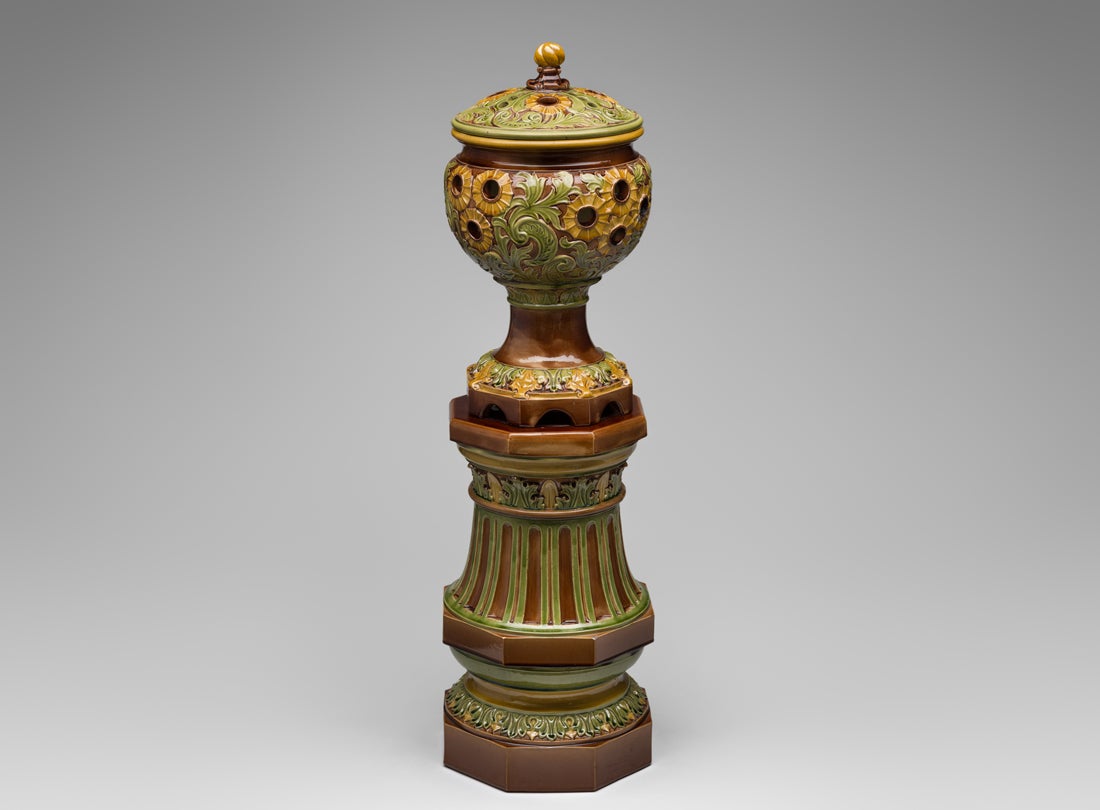
Conservatory heater c. 1885
Royal Doulton
Burslem, Stoke-on-Trent,
Staffordshire, England
stoneware, glaze
Collection of Brian D. Coleman
L2025.0501.017a,b
Conservatories
Elaborate public and private conservatories were constructed in the nineteenth century. Built from iron and glass on an unprecedented scale from 1844 to 1848, the Palm House at Kew Gardens in London continues to serve as a botanical and scientific study center. It houses the world’s oldest potted plant (1775), an Eastern Cape giant cycad (Encephalartos altensteinii) collected from South Africa. An extraordinary example of a municipal conservatory constructed of wood and glass, the Conservatory of Flowers opened in 1879 in San Francisco’s Golden Gate Park—the oldest of its kind in the nation. From its inception, the conservatory became one of the park’s most popular attractions, allowing city dwellers to experience rare and unusual tropical plants. Today, it continues to epitomize the Victorian era’s passion for plants.
Smaller conservatories or solariums attached to houses allowed gardening enthusiasts to create microclimates where they could cultivate tropical and flowering plants year-round. These sunrooms were often adorned with furniture and other décor for entertaining guests or for relaxing. For those living in urban environments with limited space, a bay window protruding outward from the wall could serve a similar function. The leading amateur gardening writer of his time, Shirley Hibberd, outlined many elaborate and modest options in the 1870 edition of Rustic Adornments for Home and Taste.
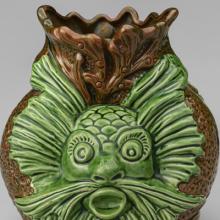
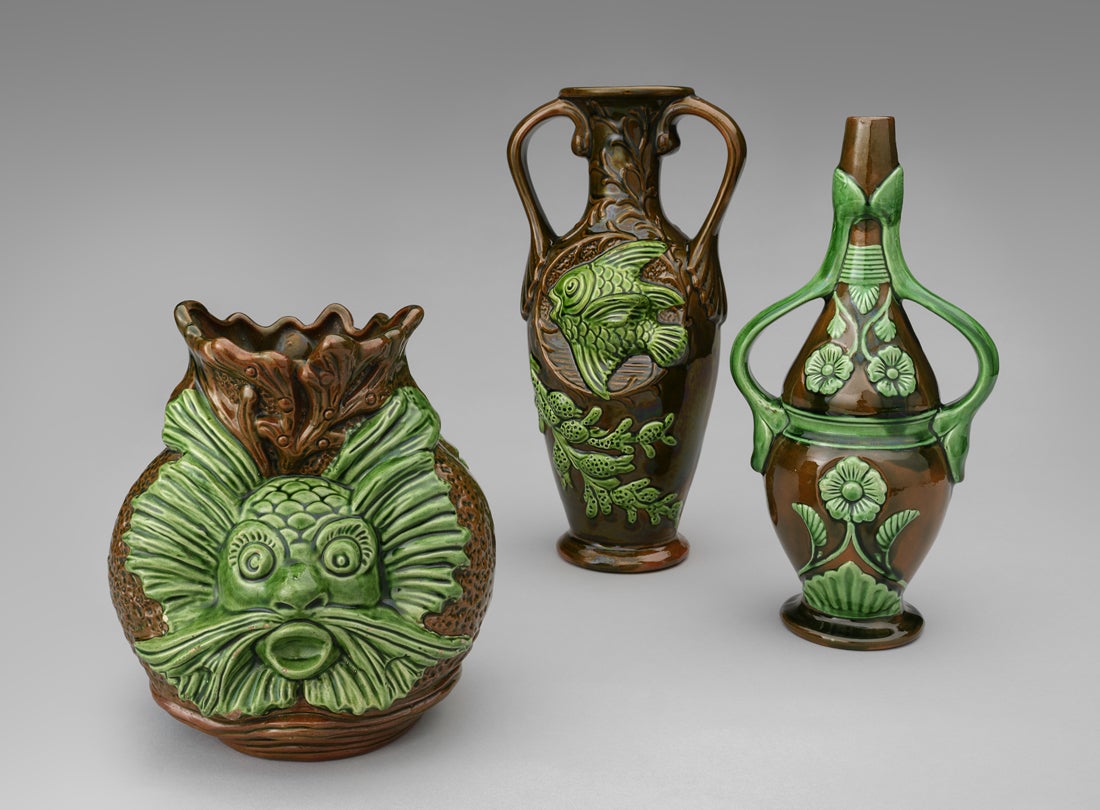
Anthropomorphic fish vase c. 1893
Designed by Christopher Dresser (1834–1904)
Ault Pottery
Swadlincote, Derbyshire, England
ceramic, glaze
Collection of Brian D. Coleman
L2025.0501.002
Two-handled baluster vase with fish and seaweed c. 1893
Designed by Christopher Dresser (1834–1904)
Ault Pottery
Swadlincote, Derbyshire, England
ceramic, glaze
Collection of Brian D. Coleman
L2025.0501.006
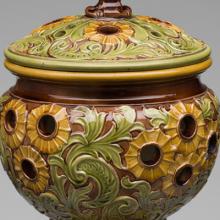
Stylized flowers vase c. 1893
Designed by Christopher Dresser (1834–1904)
Ault Pottery
Swadlincote, Derbyshire, England
ceramic, glaze
Collection of Brian D. Coleman
L2025.0501.005
Nurseries and Seed Catalogs
A network of plant nurseries operated in or near London in the eighteenth and nineteenth centuries. Loddiges & Sons Nursery, which first opened in Hackney in 1771 before closing in 1852–54, was one of London’s most influential nurseries. They imported and introduced numerous plant species from across the globe, such as Chinese wisteria from Guangzhou, China, and cultivated thousands of plants in some of the world’s largest hothouses at the time. Loddiges also developed many modern nursery practices, such as sophisticated propagation techniques. George Loddiges (1786–1846) was among the first to extensively employ Wardian cases to transport live plants on long voyages.
Not all nurseries or seed companies in Victorian England specialized in exotic plants requiring tender care. Many introduced new varieties of ornamental flowering plants, which were extensively bred and hybridized. These included pelargoniums (often called geraniums) from South Africa, as well as zinnias and petunias from the Americas. By the mid-nineteenth century, railways and improved mail service enabled these industries to grow exponentially. Printing methods also advanced, and by the 1880s, companies offered elaborate, annually published seed catalogs with striking cover artwork and botanical illustrations. In addition to seeds, catalogs also offered gardening tools and supplies, furnishings, and planters. They contained detailed descriptions of plant varieties, cultivation techniques, and advice on garden design, bringing horticulture into the hands of England’s growing community of amateur gardeners.
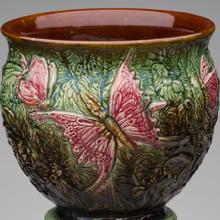
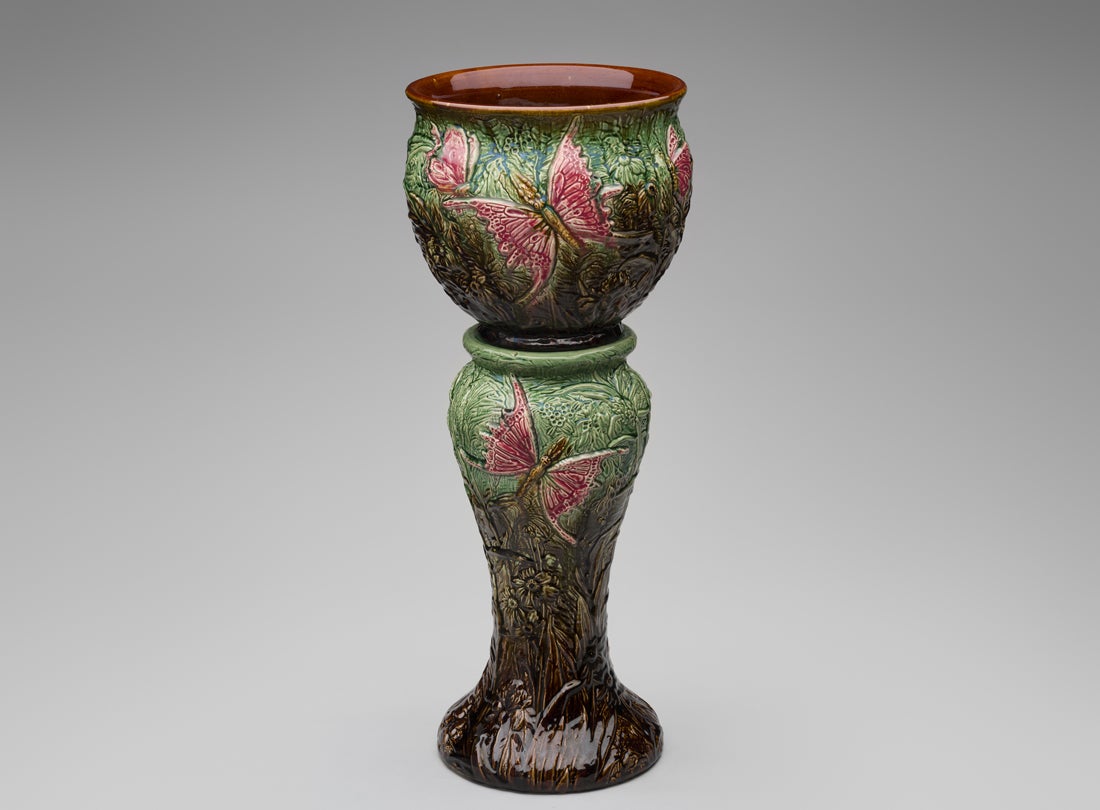
Butterfly jardinière and pedestal c. 1900
Weller Art Pottery
Fultonham, Ohio
ceramic, glaze
Collection of Brian D. Coleman
L2025.0501.024.01-.02
The Wardian Case
The Wardian case, essentially the equivalent of a modern-day terrarium, enabled plants to be transported across the globe with high survival rates. Many common ornamental plants were first transported overseas in these containers. Before the Wardian case, transporting live plants on ocean voyages proved cumbersome. Plants lacked proper sunlight and fresh water, while enduring salt spray, storms, and temperature extremes. Cuttings often died on voyages, and seeds were not always available or viable. Gardeners sometimes traveled with plant specimens to aid in their survival.
In 1829, Dr. Nathaniel Bagshaw Ward (1791–1868), a London physician and amateur botanist, attempted to hatch a moth in a sealed bottle partially filled with soil. After a length of time, he noticed a fern and some grass growing in the bottle. Without any external watering or care, he witnessed the plants thriving in this self-contained environment. In 1833, Ward sent wood and glass cases containing ferns, mosses, and grasses from London to Sydney, Australia. The following year, the cases were replanted with Australian specimens and sent back to England. Although others had come to similar conclusions, Ward had great success marketing his cases to transport plants. Ward later published On the Growth of Plants in Closely Glazed Cases (1842). By the late nineteenth century, terraria filled with ferns had become a stylish feature in many Victorian homes.