
A Century of Evolution: SFO | San Francisco International Airport
A Century of Evolution
SFO | San Francisco International Airport
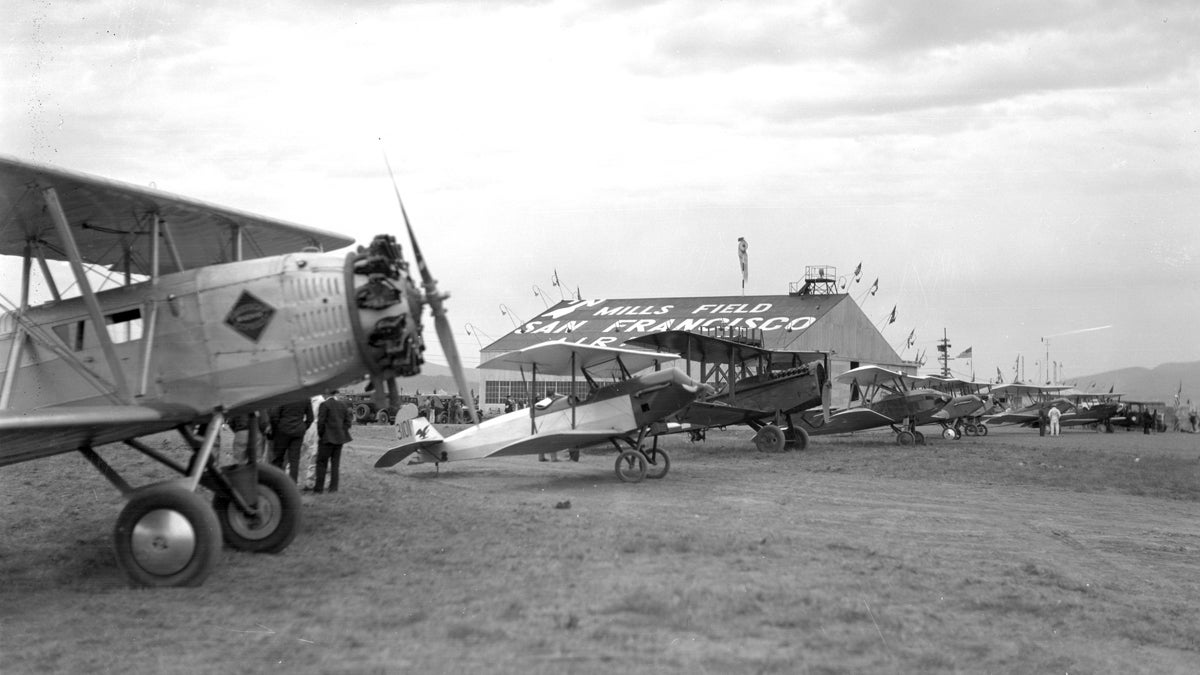
San Francisco International Airport (SFO) celebrates a remarkable centennial in 2027, tracing back to the dawning years of commercial aviation. From the airmail pilots who boldly pioneered the airways, to the sleek, swift jet airliners that routinely connect people worldwide, SFO has grown by leaps and bounds alongside the evolution of airline travel. SFO was founded as Mills Field Municipal Airport of San Francisco on May 7, 1927, on 150 acres of leased pastureland as the terminus of a new transcontinental airmail route. During the 1930s, the renamed San Francisco Airport was purchased and expanded into the bay to accommodate a new generation of larger and faster airliners. In 1954, a seven-story International Terminal (now Terminal 2) anchored new, parallel runways and an even larger airfield, renamed San Francisco International Airport. The arrival of jet airliners in 1959 signaled the modern era at SFO, and as passenger numbers skyrocketed through the 1980s, new terminals, boarding piers, and rotundas formed a horseshoe. In 2000, a spectacular 1.8-million-square-foot International Terminal, constructed over the main access roadways, completed the airport’s signature, circular layout—proudly announcing SFO as a “Gateway to the World.” As San Francisco International Airport continues to evolve, it has grown into a city within a city, beyond anything airport planners could have imagined when their experiment at Mills Field began more than a century ago.
[image]
Boeing Model 40A, American Eagle A-101, and de Havilland DH-4, from left to right, and other aircraft at “Lindbergh Day,” Mills Field Municipal Airport of San Francisco September 16, 1927 2011.032.0011; R2027.0701.015