
One Step Beyond: Fortune Telling and the Paranormal
One Step Beyond: Fortune-Telling and the Paranormal
For centuries, people have turned to fortune-telling to predict the future, employing a variety of tools. Tarot cards appeared in Europe in the 1400s, but it was not until the late 1700s in France that they were first used for divination. The legendary French fortune teller and cartomancer Madame Lenormand (1772–1843) predicted the futures of many eminent figures in Paris. In New York City, the infamous Madam Morrow (active 1850s–70s) began advertising her psychic abilities in local newspapers in 1854. In addition to cartomancy, talking boards, palmistry, and tea leaf reading all flourished by the late 1800s, as a fascination with occult practices captivated the public. Enterprising manufacturers were quick to capitalize, offering a variety of board and card games in addition to fortune-telling devices, an array of which will be featured in One Step Beyond—from swinging pendulums to crystal balls—your future awaits.
Alongside fortune-telling, the paranormal attracted serious scientific scrutiny. The British Society for Psychical Research, founded in London in 1882, investigated spirit communication, telepathy, and hypnosis, and was soon followed by its American counterpart in Boston. By the 1930s, parapsychologist Joseph B. Rhine had popularized the term ESP or extrasensory perception while researching the subject at Duke University’s Parapsychology Laboratory. ESP cards, aura goggles, and a Mystic Ball promising to unlock the secret powers of your subconscious mind are a few of the many paranormal items in One Step Beyond that demonstrate the allure of psychic phenomena. What do you believe?
[image]
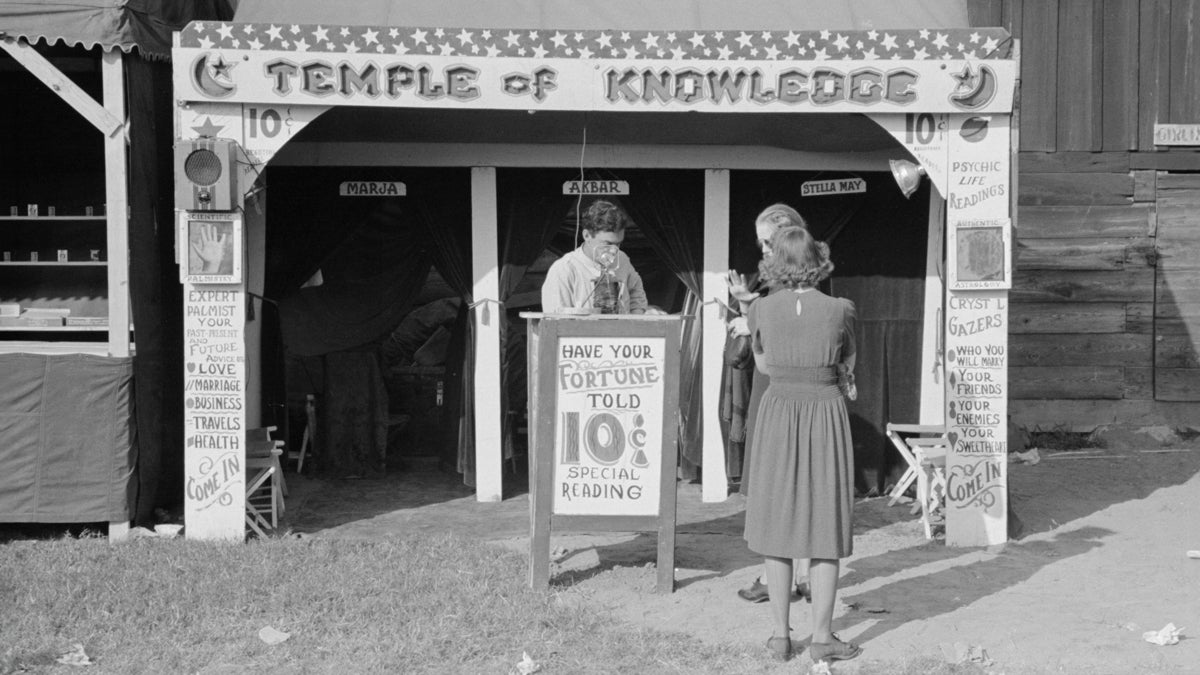
Fortune teller’s cubicle at the state fair 1938
Photograph: Russell Lee (1903–86)
Donaldsonville, Louisiana
Library of Congress, Prints and Photograph Division
LC-USF33-011786-M2