Lowrider Bikes: Familia y Cultura

Lowrider Bikes: Familia y Cultura
Lowriding is an artistic expression of identity. Far more than a style or pop-cultural phenomenon, lowriding is a way of life, a powerful movement that celebrates diverse cultures bound by community, family, strength, and tradition. Both a person and a vehicle may be defined as a lowrider. Together, they move “low and slow,” proudly cruising at their own pace with pride. Lowriding is multigenerational and transfers culture, knowledge, tools, and vehicles through family lines. Parents often introduce children to lowriding by building bicycles as collaborative projects. People also discover lowrider bicycles through other family members, friends, or on their own. While some transition to customized cars as they grow older, many lowriders maintain a lifelong dedication to building, riding, and displaying their bikes.
Bicycles have been integral to lowriding since the movement began in the late 1940s. Like their modern counterparts, early lowrider bicycles featured custom paint jobs, lowered seats, modified handlebars, and other parts and accessories that reflected the personalities of their builders. While various bicycle makes and models have been customized over the years, Schwinn remains the preferred brand. Schwinn’s legacy was solidified in 1963 when they introduced the Sting-Ray, a small, sporty bicycle that has reigned supreme as the lowrider of choice. As customized Sting-Rays took to the streets, lowrider car shows also grew in popularity and featured bicycles in their own categories. Lowrider Magazine included bicycles in its first issue in 1977, and in 1993 Lowrider Bicycle Magazine was created during a resurgence in lowrider bike building.
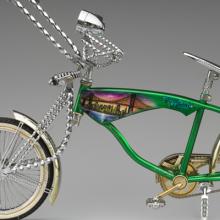
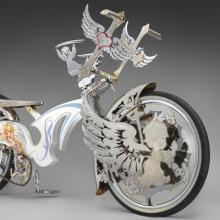
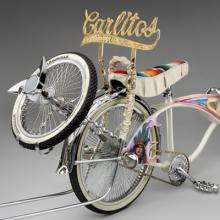
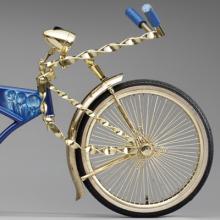
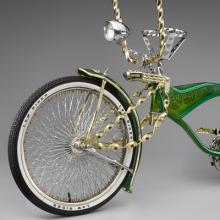
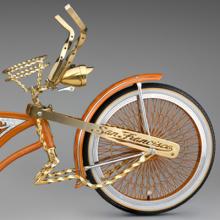
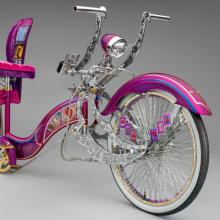
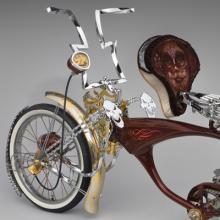
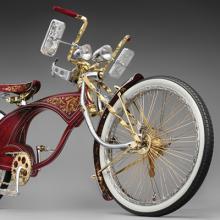
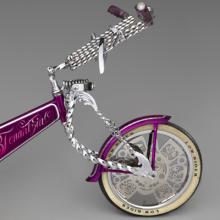
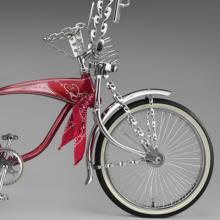
 Modifications to lowrider bicycles abound. They include raking the handlebars forward and re-arcing or replacing the front forks to lower the entire bike. Custom parts are plated in chrome or gold and may be engraved with swirling scrollwork designs. Accessories such as side mirrors and faux exhaust pipes mimic custom motorcycles, while intricate, multi-layered paint jobs emulate the artistry of lowrider cars. Sheet metal inserts are often welded between the frame and filled to provide a canvas for airbrushed murals that showcase the theme of a bicycle. The most elaborate builds feature custom-fabricated metalwork that encloses or replaces the frame to reshape the bike. Some lowrider bikes are made to ride and display, while others are built strictly for competition at shows. As a teenager, longtime bicycle builder José R. Laguna asserted: “a lowrider bike should be a way of expressing someone’s heart, someone’s style…you’re not just showing a bike—you’re showing an image of you.”
A Brief History of Lowriding
Lowrider cars showcase custom paint jobs, brightly plated and engraved metal, plush upholstery, and modified suspensions and wheels that lower them close to the ground. These rolling works of art reflect their owners’ passions and personalities and can take hundreds to thousands of hours to complete. Lowriding is rooted in late 1940s California, when automotive enthusiasts in Mexican-American communities began lowering and personalizing cars that were passed down or purchased secondhand. These early lowriders modified their vehicles to drive bajito y suavecito, or “low and slow”—in stark contrast to the predominantly Anglo-American, speed-centric “hot rod” phenomenon that developed at the same time. During the 1950s, driving along a specified route merely for fun and “cruising” became a pastime enjoyed by people in all types of vehicles. Enthusiasts from different cultures began customizing and lowering their cars to express themselves on the streets and at shows. However, in 1958 California Vehicle Code 24008 established a minimum distance between the bottom of a car and the road. In response, lowriders developed hydraulic suspensions using surplus aircraft parts, so that cars could be raised or lowered at the flick of a switch.
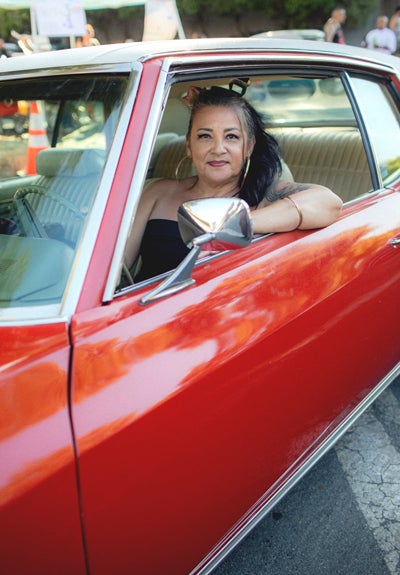 Lowriders from Brown and Black communities faced increased racial discrimination and targeting by police as the movement gained momentum. Chicano and Lowrider Studies professor Denise M. Sandoval points out, “the term lowrider, which began as an insult, took on new meaning as youth and young adults redefined it as a source of cultural pride.” Lowriding was further criminalized in the 1980s and ‘90s when cities throughout California implemented anti-cruising laws, driving lowriding underground. At the same time, film, music, and other media portrayed lowriders as criminals and gang members, casting myths that have negatively stereotyped the movement. Realizing the need for an outlet, Lowrider Magazine and other publications celebrated lowriding’s creativity and culture. They organized competitive shows with multiple classes and categories that still provide a haven for lowriders to express their artistry. Lowrider councils and coalitions formed to battle discrimination and alter public misperception, advocating for their rights and strengthening their communities. Local and statewide lobbying by lowrider groups prevailed on January 1, 2024, when California Assembly Bill 436 abolished anti-cruising laws and rescinded code that limited vehicle height. As the movement grows and evolves worldwide, lowriding remains a powerful and celebratory counterculture, providing an avenue for sociocultural continuity, resistance, and education.
Thank you to Freddy Alfaro; Paul Camilleri; Tyrone “Malow” Diaz; Paulee Feliciaño; José, Alejandra, and José Laguna, Jr.; Renée Lopez; Vince, Joseph, and Mauricio Mabutas; Peter and Giovanni Miranda; Liz Perez and Izzy Dueñas; Brenda Rodriguez and Benny Romero; Sair, Uciel, and Carlos Rodriguez, Jr.; Vic and Diego Rodriguez; Jorge Herrera Vargas; and José and Bertha Yepez for making this exhibition possible.
Learn more! Download the Lowrider Bikes: Familia y Cultura education program.
@SFOMuseum
#LowriderBikesSFO
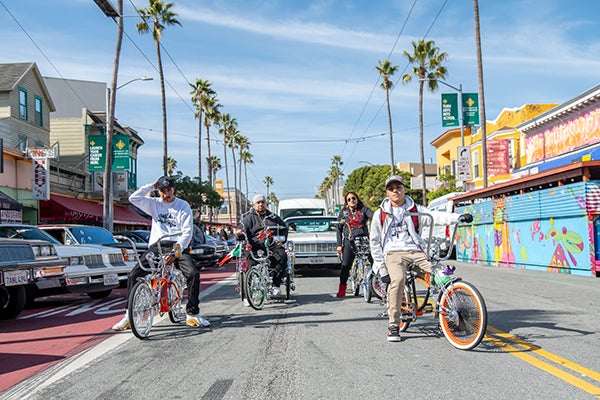
[inset image, top]
El Yepez Customs Bicycle Club in the Mission District 2024
Tyrone “Malow” Diaz
San Francisco
Courtesy of the artist
R2026.0311.001
[inset image, bottom]
Lowrider at Blvd. Nights 2024
Renée Lopez
San José, CA
Courtesy of the artist
R2026.0312.002
© 2026 by San Francisco Airport Commission. All rights reserved.